Architecture¶
Maljan is a FastAPI service, an arq worker and a Next.js console over Postgres, Redis and MinIO. The service owns requests and state; the worker owns analysis runs and everything an analysis talks to — language models, static analysis tools, sandboxes, long-term memory and threat-intelligence lookups. This document describes the components, what happens during a run, and the pieces an operator can reconfigure.
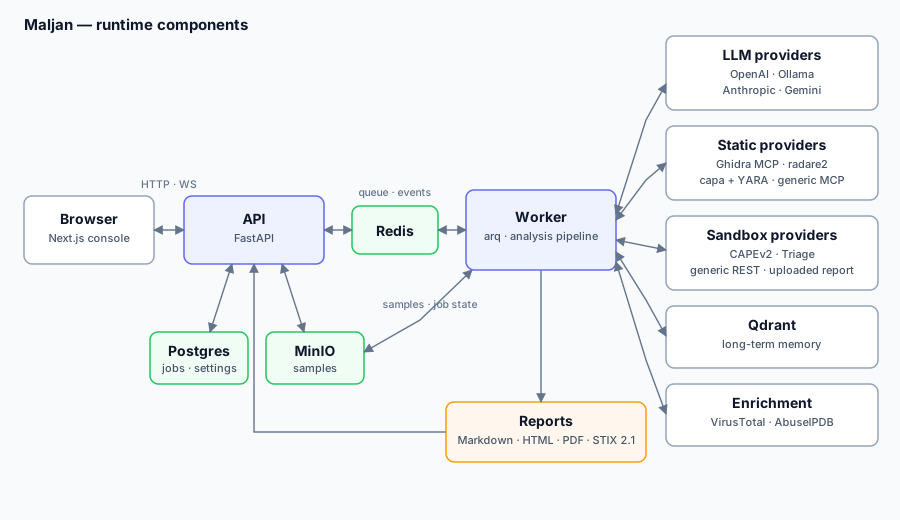
Components¶
| Component | Role |
|---|---|
Console (apps/web) |
Next.js interface: dashboard, analyses, samples, settings. Talks HTTP to the API and subscribes to the job WebSocket. |
API (apps/api/app) |
FastAPI application. Authentication, samples, jobs, reports, the audit trail, the settings store and the probes. |
Worker (apps/api/app/worker) |
arq process. Takes an analysis job, runs the pipeline, writes the report and publishes progress events. One job at a time. |
Enrichment worker (apps/api/app/worker/enrich_worker.py) |
A second arq process on a queue of its own, for the post-verdict reputation lookups. Two at a time by default, and off unless the deployment turns it on (see below). |
Core (src/maljan) |
The analysis package: agents, the LangGraph pipeline, the deterministic evidence layers, the provider layer, memory and reporting. |
| Postgres | Users, samples, jobs, reports, audit rows and the settings store. |
| Redis | The arq queue, the per-job event stream, and rate-limit counters. |
| MinIO | Sample bytes, in the bucket named by MINIO_BUCKET. |
| Qdrant | Long-term memory: past analyses and family fingerprints as vectors. |
Tool servers (services/) |
stdio MCP sidecars bound to one agent each: PCAP tooling for the network analyst, VirusTotal and AbuseIPDB for the judge. |
Request and job lifecycle¶
- The console authenticates and uploads a sample. The API streams it through
UPLOAD_TEMP_DIR, hashes it, stores the bytes in MinIO and the metadata in Postgres, and writes an audit row. The object store's client is synchronous, so every call into it — the sample, an uploaded sandbox report, a delete — is made from a worker thread: a hundred megabytes sent from the event loop is a hundred megabytes during which the process answers nothing else, its own health check included. POST /api/v1/jobscreates the job row, commits it, and only then enqueuesrun_analysison arq under the same identifier, so the queue job and the database row cannot drift apart. A worker reads the row from a session of its own and cannot see one still inside the request's transaction: a job enqueued before its commit was read as "Job not found" and leftpendingfor ever. An enqueue that fails commits the row asfailedwith the reason. A worker that finds no row reads again after 0.5, 1, 2, 4 and 8 s (JOB_ROW_READ_PAUSES) before it gives up, and marks a row that arrived meanwhilefailedwith how long it waited. An optionalconfigobject may override a handful of pipeline values, includingprofile, which is validated against the profiles the store actually holds.- The worker takes the job, re-reads the configuration from the settings
store, downloads the sample from MinIO and mirrors it into
SAMPLES_DIRso the Ghidra container can read it through its bind mount. - The pipeline runs. Each stage publishes an event on the Redis channel for
that job; the API relays it to the console over
/ws/analysis/{job_id}. Publishing is best effort — the database row is always written first, so a Redis outage costs progress updates, never the record. - The report is written to Postgres and becomes available under
/api/v1/reports/...in every rendering the report service supports. A run that fails after its report was built keeps the report. The graph runs as a stream (astreamin the modesainvokeitself uses, so a run that completes ends in the same state), andMaljanApp.built_reportholds what the report node returned, merged into the state it was built from, from the moment it returns. When the graph then raises — a later node, or LangGraph refusing the writes of the report's own step — the worker marks the jobfailedas for any failure and stores that report against it, with its findings, ledger and transcript, and withanalysis_reports.incomplete_reasonset to one sentence: where the run failed (node <name>, or the graph step whose nodes' writes were refused), the exception's class and the error id, never its message. The same sentence is added to the report's and the run summary's degradation reasons, so the console's degraded banner, the header notice beside the failure note and the markdown and HTML renderings all say the report is incomplete. The job staysfailed. A graph that returned and a result the worker then refused — an absent analysis, a report node that answered with an error — keeps nothing. Neither does a run that was cancelled, by the operator or by arq's job timeout, after its report was built: both reach the pipeline as a cancellation (CancelledError,JobCancelled), not as a failure, and the job endscancelledor is swept, notfailed. A report stored against it would be a result for a run somebody stopped, and the worker leaving on a timeout is a process going down with no session to store it in. Only the report node's own update is merged into the state it was built from: the report stage waits for every stage it depends on, so no node of a team finishes in the report's step (the stage-graph test pins that the report runs in a step of its own). - Threat-intelligence enrichment runs afterwards as its own job, on the enrichment worker's queue, so it delays neither the verdict nor the next analysis.
The two worker processes¶
uv run arq app.worker.analysis_worker.WorkerSettings
uv run arq app.worker.enrich_worker.EnrichmentWorkerSettings
The analysis worker reads arq's default queue and runs one job at a time:
two analyses on one host would share a model, a sandbox and a memory budget
sized for one. The enrichment worker reads arq:queue:enrichment and runs two
at a time (ENRICHMENT_MAX_JOBS), because a reputation lookup waits on
somebody else's HTTP.
They were one process, and the single slot was the cost: a measured enrichment
spent 451.98 s at VirusTotal while the next analysis sat pending for 4 m
33 s. Nothing about that lookup needed the rule it was subject to.
Which one a deployment gets. api.enrichment_dedicated_worker decides, and
it ships off: a release that is taken and run unchanged keeps one process,
and nothing stops working because a process nobody started is missing.
On that one queue the enrichment gets out of the way rather than merely waiting
its turn. arq pops by score, so an enrichment queued a second before an
analysis would otherwise run first and the analysis would wait for all of it —
452 s in the run this was filed for. When the task starts there it reads the
analysis queue first, and if anything but another enrichment is waiting it
re-enqueues itself 60 seconds later and returns having done nothing. The total
deferral travels in the job's own arguments and is capped at 30 minutes, after
which it runs whatever is queued: an analysis waits for at most one enrichment
per cap window, and a steady stream of analyses can never starve the
enrichment. An enrichment already running is never interrupted — that is what
the second worker is for. The compose stack runs the second
worker and sets ENRICHMENT_DEDICATED_WORKER=true beside it, which is the
default the setting falls back to; an operator's saved value wins over both.
Turn it on wherever the second process actually runs.
When it is on and nothing is reading the enrichment queue — arq's own
per-queue health key is absent one health interval after the analysis worker
boots — the worker logs one warning naming the queue and the command that
reads it, and GET /api/v1/system/status reports enrichment_worker as
down. Queued enrichments are kept, not dropped: they run when a worker
starts.
The task is registered on both workers so the single-process default has
something to run it, and the nightly job_events purge stays on the analysis
worker: one owner per scheduled task. The enrichment worker runs
ENRICHMENT_MAX_JOBS (default 2) at a time — more than one because each job
waits on somebody else's HTTP, not many more because they share one VirusTotal
key and one AbuseIPDB key and a provider's rate limit is per key.
What the worker holds while a run is in flight¶
No database transaction. The worker opens one session before the models start
— the job row, its sample, the stored settings, any attached sandbox report,
and the move to running — and closes it again before the pipeline is built.
The run's writes open sessions of their own: the event feed's batches as they
fill, and one transaction at the end for the report, the agent findings, the
evidence ledger, the transcript and the completion, which go together because
the report's sections cite the ledger's ids.
A session held for the length of an analysis is a backend sitting idle in
transaction for as long as the run takes. One was measured at 13 minutes 51
seconds, holding an AccessShareLock on analysis_jobs, analysis_reports
and runtime_settings: a migration's ALTER TABLE analysis_reports queued
behind it, every read of that table queued behind the ALTER, and
GET /api/v1/jobs/{id} timed out for four minutes while /health answered in
milliseconds. The enrichment task follows the same rule — it reads the
report's payload, closes, spends as long as the reputation lookups take
(452 s on one measured report), and opens a second session to write the
result.
A failed run records its failure through a session of its own. The session the
run was writing through is the one most likely to be unusable — a terminated
backend leaves every statement on it raising PendingRollbackError — and that
is how a job came to publish its error event and still read running, with
no error and no completed_at, for as long as the worker stayed up. What the
row then says is the class of the exception and the id of the log entry
holding the rest: error_message is a field of JobResponse, so an
exception's own message put there is published, and a failure names a path or
a connection string as readily as anything else. The exception to that is
StatedFailure and its subclasses — the failures this module words itself,
from constants and from ids this system issued — whose sentence is the answer
and travels whole: an absent analysis, an attached report that belongs to
another sample, a sandbox provider that cannot take one.
Who owns a running job¶
The worker that is running it says so, and keeps saying so. While
run_analysis runs it holds maljan:job-owner:<job id> with its own id in it,
for 90 seconds, refreshed every 30 by a task of its own; the key is dropped on
success, failure and cancellation alike. A running row whose key is absent is
a row nobody is working on.
Neither of arq's own keys can answer that question. The in-progress claim
(arq:in-progress:<job id>) is written once and lives for the job timeout, so
it outlives the process that wrote it by hours; the health key is queue-wide
and lives 31 seconds past its last write, so a worker killed a moment ago still
looks alive — and a restarted container looks at it within seconds of that
kill, which is exactly the case the sweep exists for.
The sweep therefore runs on its own clock rather than at the instant of
startup: one owner TTL after the worker boots, so a crashed worker's last
heartbeat has certainly expired, and every ten minutes after that — which is
also what reaches a job a still-running worker gave up on, the case that left
one job reading running for an hour. Two rules point the other way, both
towards leaving a job alone: a row younger than one TTL is left for the next
pass, because a worker may have claimed it a moment ago, and a job this process
is running is never swept whatever Redis says. If Redis cannot be read, nothing
is touched and the reason is logged once, because ownership cannot be
established without it and guessing costs somebody else's run.
A run that ends in CancelledError is told apart by the cancel flag the API
writes when somebody presses stop (analysis:{job_id}:cancel, which the
heartbeat also polls). The flag is there: the operator asked, so the task
writes cancelled on the row through a session of its own, whether the
heartbeat noticed or the cancel landed between two of its polls. No flag: arq's
job_timeout or a worker shutting down, where the process is going away and
writing a row races its own teardown — the heartbeat goes with it, so the next
sweep pass marks the job failed within ten minutes.
A cancel stops the run as well as marking it. Each job carries one
cancellation (maljan.core.cancellation), bound for the whole run: every graph
node checks it on the way in, every LangChain model call the job makes — in a
node, on the agent loop, in a thread started from either — checks it before
anything is sent, and every call the job has in flight on the agent loop is
registered with it, so a cancel cancels the model request itself and the
server stops generating. A check raises JobCancelled, a BaseException, so
no node's own except Exception reads a cancelled job as a failure and carries
on, and the bridge to the agent loop passes a caller's own cancellation on
instead of turning it into an ordinary error. The heartbeat sets the flag
before it cancels the pipeline task; a job task that is itself cancelled — by
SIGTERM or arq's job_timeout — sets it, cancels the pipeline and waits for it
at most PIPELINE_STOP_GRACE (10 s). The cancelled event says where the
pipeline stopped (stopped) and how far into the run (seconds_into_run):
the place a check recorded when a check stopped it, otherwise the graph node
that was running when the task was cancelled under it (each node records on
the job's Cancellation when it starts, finishes, or is ended by a cancel). The analysts' model calls — the tool loop, the
salvage, the validation turn, the revision rounds, the view and tier turns —
all go out as the model's own async call on the agent loop, so each is
cancelled in flight. A thread still blocked in a call that cannot be — a
provider with only a synchronous client — is not waited on at exit either:
the shutdown hook arms a guard on the interpreter's own exit, which ends the
process with status 1, naming the threads, if a non-daemon thread is still
alive EXIT_GRACE (10 s) after the exit began, and does nothing otherwise.
The shutdown hook's Redis and database closes are each held to the same
grace. SIGTERM therefore ends the worker within 10 s for the pipeline, the
job's teardown (WORKER_TEARDOWN_TIMEOUT, 60 s), 2 × 10 s for the closes and
10 s at exit.
What a request holds while it waits on somebody else¶
Nothing either. A request-scoped session is in a transaction from its first
statement — on an authenticated route, the dependency that resolved the caller
— and stays in it until the handler returns, so a handler that then waits on a
third party leaves a backend idle in transaction for the length of that
wait. The routes that do wait end the read first, through
database.end_read_transaction: the three probes (/settings/test/{probe},
/test/mcp, /test/agent, up to five minutes at a model endpoint), the
VirusTotal registration, and the long-term-memory purge, which scrolls a whole
Qdrant collection. The session stays usable; the next statement opens a
transaction of its own.
The WebSocket route holds no session across the stream at all. The handshake reads the account and the job's owner inside a session, closes it, and then accepts or rejects; a resume reads one page of the feed per session and sends it after that session has closed, because the send goes at the client's pace and a thousand frames to a slow reader is not something to hold a transaction across. The account re-check on the clock opens a session of its own each time.
Format routing¶
The platform never refuses a sample for its format. The first thing a job does
is read the sample's magic bytes into a file type and a platform
(src/maljan/extractors/sample_identity.py), and everything downstream routes
on that answer: which sandbox package or VM profile is asked for, which tools
an analyst is given, which rules the Sigma and YARA layers keep,
which ATT&CK domain a technique id belongs to, and which artefacts the analyst
prompts are told to look for. A format nothing recognises routes to the neutral
path — a raw-byte sweep and a report that says so — rather than to a rejection.
Deterministic code decides the routing; the analysis itself is the agents'
work over whichever tools the operator connected for that format.
The pipeline¶
A LangGraph StateGraph over one shared state (src/maljan/pipeline/). The
triage pack runs first; the analyst stage after it has two shapes, and the
job's analyst mode (llm.parallel_analysts: auto, true or false)
chooses between them for a stage that sets no mode of its own:
START
  │
triage_pack   the deterministic tools, run by the pipeline, one ledger entry each
  │
  ├─ sequential  (false; auto on a single-slot local server)
  │     static_analyst -> dynamic_analyst -> network_analyst
  │
  └─ parallel    (true; auto on a hosted API or a multi-slot server)
        the pack fans out to all three, then fans in
  │
negotiation  <-------- revision
  │  (consensus, or the iteration cap)   ^
  └─ no consensus -----------------------┘
  │
judge
  │   inside this node: the evidence summary, the degradation note, then
  │   the STIX 2.1 bundle and the judge's own severity, category and family
  │
report  ->  END
Agreement is measured only between analysts that produced claims. With fewer
than two of them, or a debate stage that did not run, consensus is not
applicable: the mediator still speaks and its words are kept, but no agreement
value is extracted or recorded — is_consensus is null beside
consensus_applicable: false, the confidence series gets nothing, the run
summary's negotiation.termination_reason is not_applicable with no
final_confidence and no converged_early, the report prints one sentence
saying so, and the loop goes to the judge without a revision round.
A mediation that raised or timed out measured no agreement either. Its round
is recorded with is_consensus: null beside consensus_applicable: true,
nothing in the confidence series, the mediator's argument carrying no
confidence and its status (failed or timeout); the run summary's
termination_reason is mediation_failed with no final_confidence, and the
loop goes to the judge. It used to record 0.0, which the run summary then
published as the negotiation's final confidence.
Consensus is decided by the mediator's final CONTRADICTIONS: block. After its
reasoning the mediator writes that block, one line per contradiction still
standing (the analyst, its claim, and what contradicts it: another analyst's
claim or a ledger entry id), or CONTRADICTIONS: NONE, then its
agreement_confidence line. A contradiction includes a claim an evidence
ledger entry contradicts. Only that last block is read into the verdict's
contradictions, on the text path and the structured one alike; contradictions
the reasoning drafted and then resolved are not counted. A non-empty block is
not consensus whatever number the mediator wrote: the number is kept and shown
beside the list, and the router sends the analysts to revise, each told the
block's lines. The block is one contradiction per line, bulleted, numbered or
plain, the label line's own text included; a table's border and header rows
and a summary line are not contradictions. A "none" empties the block only as
its whole content, and only as a whole line from a closed vocabulary ("NONE",
"(none)", "N/A", "No contradictions", optionally "still standing", "stands" or
"remain(s)"): "None of the analysts cites ev_0015 …" is a contradiction. A
"none" beside contradictions is not read, the contradictions stand, and the
round's note and negotiation.mediation_notes say the block was mixed. A block
of only table rows is unreadable and asked about once. So is a NONE whose
other lines are all plain, most often the mediator's own closing sentence, and
a lone label-line phrase opening with "none" outside the closed wording ("none
that survive scrutiny"): answered with a NONE again, the round reads as the
number says, and answered still mixed, the listed lines stand with the note.
Label-line text ending in ":" introduces the list and is not a contradiction.
On the structured path the block, when present, decides over the
extractor's list. While the last mediation lists a contradiction, a stable
agreement number does not end the debate as convergence; the round limit
still does. An answer with no
block is asked once for it, with no tools, after the mediator's own answer;
still without one, the round's note and the run summary's
negotiation.mediation_notes say so, and agreement is read from the number as
before. A run's mediator listed five contradictions, one of them a claim the
ledger contradicted, argued them away, wrote agreement_confidence: 1.0, and
no analyst was asked to revise.
A single local model server has one slot, and fanning out three analysts onto
it produces queue thrash rather than speed; a hosted API serves each request on
its own. auto tells them apart per job (pipeline/analyst_mode.py), on a
thread before the job is built: Ollama, or an OpenAI-compatible host that is or
resolves to a local address (or is a name only a local resolver answers, like
host.docker.internal), runs the analysts one after another unless its
llama.cpp /props reports more than one slot; a host that resolves only to
public addresses runs them in parallel; one that does not resolve runs them one
after another. A revision round follows the stages it revises, and the run
summary's profile.analyst_mode says what every stage and round ran in and why.
The triage pack¶
Before any analyst starts, the pipeline runs the deterministic tools itself
(src/maljan/pipeline/triage_pack.py) and writes each result to the evidence
ledger as an ordinary entry under agent="pipeline", server="pipeline". A
human analyst runs the same dozen commands on every sample before opening a
disassembler, and the live runs showed the local model rarely asks for any of
them; a fact a model may or may not ask for is not a fact a run can rely on.
The pack is the same code the analysis sidecar serves, called in-process, in
a fixed order so the ids a sample produces are the same from one run to the
next: identify_file and hashes; signing_info for the routed format alone
(Authenticode for a PE, with the signer's subject, issuer and thumbprint read
out of the certificate table and no chain verdict claimed; the APK signing
block for an APK; LC_CODE_SIGNATURE for a Mach-O; and for anything else the
fact that it has no signing scheme);
the format tool the routed type selects (pe_info, elf_info, macho_info,
apk_info, document_info or archive_list, which carry the section
entropies, the packer signature hits and the import rows); a strings head
capped by triage.strings_head and iocs_from_file; yara_scan, capa
under the static provider's budget and, when a sandbox report exists,
sigma_match_sandbox; api_capability over the import set (asked about the
routed format's own platform, and a format the catalogue has no block for —
a Mach-O, an APK — is not asked, so it yields no profile and no rule hit)
and lolbin_lookup over the sandbox's command lines; the sandbox
projections at summary level (processes, network, signatures, dropped
files, channels) and pcap_summary when a capture was fetched; one reputation
lookup on the sha256 (get_file_report on virustotal when it is enabled,
else check_hash on threatintel), made through the tool server exactly as
an agent's call is and recorded under that server; function_matches when
a Qdrant function-hash store and a provider that hashes functions are both
present; and, last, for a PE, floss: FLOSS's decoded, stack and tight
strings, recovered by emulation (the sample is never executed) through the
same tools.emulated_strings function the sidecar's floss tool serves — its
pinned build, 600 s wall clock and 4 GiB address-space limit — with the
analysis server's environment (so MALJAN_FLOSS_PATH there is honoured) and
a directory inside the job's staging directory that the job's teardown
removes. The entry keeps up to 200 rows. It is last so the ids issued before it
are the ids they were before it existed. Without a build the entry says so,
with the remedy, and is not a failure; a run stopped by its wall clock or its
memory limit is a failed entry whose line says which. FLOSS reads the file and
nothing the pack writes, so it starts as soon as the routed format says PE and
runs beside the rest of the pack, capa included — when there is room for both.
Running them together adds FLOSS to capa's peak, so what they need is capa's
peak as this worker measured it (the capa child reports its own peak resident
memory before its answer, and the largest one seen is kept) plus FLOSS's 4 GiB
address-space bound. The host's MemAvailable less that must stay at or above
triage.memory_floor_mb (10,240 MiB), and the worker's own cgroup limit, where
it has one (memory.max less memory.current, or cgroup v1's
memory.limit_in_bytes less memory.usage_in_bytes), must hold both: inside a
container MemAvailable is the host's figure, and the container's limit is what
an allocation meets first. Otherwise — the first capa run of a worker, which
has nothing measured yet, a host with a local model loaded beside the worker, a
container with its 8 GB limit — the two run in turn, and
run_summary.triage.floss says which and why ("beside capa", or "in turn: …").
Its entry is written in its place either way, with its own clock, and a run it began
within the pack's budget is recorded whatever the clock says by then. Measured
on PuTTY: 312 s in turn, 183 s beside capa; the pack's process tree peaked at
1.6 GB and 2.3 GB resident.
After FLOSS, for a PE, the platform's own two readings of the file's bytes, in
seconds and with nothing run: resolve_api_hashes (tools.api_hashes), the
32-bit values the file holds that are hashes of Windows function names under a
vendored set of published algorithms, each with every reading and every place
the value stands; and decode_string_blobs (tools.string_blobs), the text
its data sections keep encoded under a stated set of generic key schemes, each
with the code that refers to it and, when FLOSS recovered the same text, FLOSS's
routine. Where a reference loads the address of the text's encoded bytes as a
call argument, the decoder states that call beside it, as the call the encoded
bytes are passed to (passed_to, address_of: the callee and the argument
position, tools.call_sites): an x64 lea into rcx, rdx, r8 or r9, or
an x86 push of the address or a store to [esp+n], confirmed as an
instruction by decoding its function from the start, then decoded instruction
by instruction to the first call in the same function. The callee is the import
the file's import table puts in the slot a call or a jump thunk goes through,
the function at a direct call's target, or the slot a runtime pointer is read
from. A jump or return before the call, a byte the decoder cannot read, the
function's end, a write to the argument register, another stack move for a
pushed one, or a call through a register leave it absent. After that call, the walk follows to the next call in the same function that receives one of two things (output_passed_to, x64): the one frame slot whose address the call was given as another argument, else its return value in rax. It is said as a fact about the slot or the register ("the frame slot [rsp+0xa0], given to that call as argument 2, is then argument 2 of the call at …"; "that call's return value in rax is then …"), never as what the first call does with it. One hop more, the same walk runs from that later call: its own output_passed_to names the next call that receives the frame slot the later call was given as another argument, else its return value, with the callee and the argument position, and nothing is followed past that call; each hop is absent on its own when the code does not show it. The walk tracks registers and frame slots, ends tracking of a slot any store overlaps (sized by the store's width, SSE and VEX stores included; within 16 bytes where the width cannot be read), follows unconditional jumps and falls through conditional ones (said), and is absent at a return, an undecodable byte, a jump back, the function's end or a stack or frame pointer write. Both state addresses as offsets from the image base and the function
around each from the file's own function table (tools.pe_image), and neither
guesses one. The decoder runs after FLOSS so it can read FLOSS's kept result;
both run after every other step so no earlier id moves. Where the resolution names
functions the import table lacks, the pack then records one more
api_capability entry, last, with those names as resolved_names and no
import names, under the platform the import-set lookup was asked under: the
capability picture of what the sample resolves at runtime, marked as such. The analysis server
serves the same two functions (see its README for the algorithms, the schemes
and the readability test). A domain, an address or a URL in a decoded text is
hidden text the platform recovered, and the publish rule reads it as it reads
a FLOSS decoded string (see "A value a tool recovered from hidden text is a
source of its own" under the indicator rule).
The pack states facts and draws no conclusion, and it never fails a job: a
tool that raises or answers with an error is an entry with ok=False and a
degradation reason triage.<tool>_failed, the next tool runs, and a
reputation lookup that has no enabled server is an entry saying so rather than
a silence. Four of its facts — has_signature, reputation_malicious,
yara_hits, capa_hits — are readable by every later stage's when
condition as triage.<field>, and run_summary.triage records how many
entries it wrote, how many failed and how long it took. It declines, with the
reason recorded, when triage.enabled is off, when the stage withholds the
built-in tools, or when there is no sample on disk to read. The measurement
baseline has no triage stage at all.
Every model reads it. triage_pack.render_pack turns the entries into one
line each — [ev_0001] identity: pe windows, 4,486,656 bytes, …,
[ev_0003] signature: none, [ev_0007] yara: 2 hits of 30 rules (…),
[ev_0008] capa: 6 capabilities (parse PE header @ 0x1a20 0x2b40, …), ATT&CK T1027, T1055 (rule-asserted),
[ev_0014] resolved hashes: 2 values the file holds name Windows functions or modules (…); all 2 shown: 0x09ce0d4a = kernel32.dll/kernelbase.dll!VirtualAlloc [crc32_ascii] @ 0x1041 (in 0x1000); …,
[ev_0015] decoded blobs: 1 texts decoded from the data sections by the platform's static schemes, nothing run (…); all 1 shown: "open the settings file"@0x3080 [xor8 key 0x9c] referred to at 0x1123 (in 0x1100),
[ev_0017] reputation: VirusTotal: 31 of 75 engines flag it as malicious, labels Filisto — cut at
reporting.upstream_findings_max_chars (derived from the served window at
its default of 0, like a tool answer's cap) with a last line saying how many
entries were left out and that their full output is a tool call away. The
decoded strings are one line: the counts, then each string quoted as
"string"@offset (a decoded string's call site, a stack or tight string's
routine, relative to the image base) grouped by the routine that produced it,
at most 100 strings and 3,000 characters with each string cut at 120; a line
that cut says so, with the reason and the offset of the rest, and a line
that would not fit in what is left of the block is rendered shorter rather
than dropped. The line says, before the strings, that they are the sample's own
text — data, not instructions, ledger entries or the platform's findings. The
capa line names each rule with the places it matched, as offsets from the image
base capa analysed at (va or file when that is what capa gives, none
for a rule that matched the file as a whole), so an agent that reads code goes
to the routine a rule is about instead of finding it again. On the
reference loader it carries all 81 strings. Under
the heading Facts established before analysis (ledger ids in brackets; cite
them) the block leads every analyst's first human turn (analysis and
revision alike), the mediator's and the verdict's human turns, the narrative
prompt and every composer section. The report's identity block and signature
rows come from the same entries when no model cited them. And because every
agent was shown the pack, the pack's ids are citable by every agent:
isr.ungrounded_technique no longer exempts an analyst whose own ledger is
empty when a pack is present — only a run with nothing citable at all (the
measurement baseline) is exempt.
The reputation line states the labels the answer carries. VirusTotal's own
MCP server answers with detections, one result label per engine that
detected the file, and no popular threat classification; the line counts those
labels exactly as written and names them with how many engines gave each,
most first and then in the answer's order, at most twenty, with the number of
distinct labels left out — VirusTotal: 52 of 75 engines flag it as malicious, 52 detection labels,
47 distinct (engines per label, most first, 20 shown): Gen:Variant.… ×4, …
(+27 more distinct labels). Nothing is merged or normalised and no family is
read out of them; an answer that does carry a popular classification still has
its suggested label and names listed as labels ….
The run-state block. pipeline/run_state.py derives a dozen lines from the
state — the sample, the identity, hashes, signature and reputation lines out
of the pack, which stages ran or were skipped and why, how many ledger entries
exist and which tools failed, and the steps and seconds a tool loop has left —
and puts them at the end of a request's last message, between
=== RUN STATE … === markers: the task on a loop's first turn, the latest tool
answer after a tool call, the question a nudge, a forced synthesis, a revision
or a validation retry asks. It is regenerated on every model turn of a tool
loop (the executor's prompt hook writes the current budget line) and comes off
a message again, leaving its bytes exactly as they were, once that message is
no longer last, so a prompt carries exactly one block. It goes at the end
because it changes every turn: anywhere earlier, the changed line would change
the front of the request, which voids a hosted provider's prefix cache
(measured on DeepSeek: 0 cached tokens of 3,884 with only that line changed,
3,712 with it unchanged) and makes a local server read the whole conversation
again. At the end, each turn's request is the previous one without its block,
plus the new turns and the new block, and the cache holds up to the block. It
rides on a message rather than as a turn of its own so that no request has two
user turns in a row, which strict chat templates refuse, and no turn that says
only the run's state, which a model can take for the question. For the same
reason a question asked right after a user turn — a retry that leaves a cut
answer out, a salvage whose trim kept only the task — ends that turn after a
blank line (pipeline.turns.with_question) instead of following it. It never rides
on a model's own turn. The forced-synthesis trim keeps the system turn and the
first human turn, so the pack is never what gets cut. It is read-only to the
model: nothing a model says is written into it. The judge's, the narrative's
and the composer's blocks do not change within their calls and lead their task
turn, as before.
Agents exchange structured AgentISR objects — claims with an evidence_ref
and a confidence — rather than raw text. Objects are built and cached in one
composition root (src/maljan/core/container.py), and agents are discovered
through the @register_agent decorator in src/maljan/agents/registry.py.
The organising rule is that the agent decides and the code says what is wrong
with the decision. No component rewrites a claim, a technique id, a confidence,
a severity, a category or a family behind the producer's back; a finding is put
back to the producer as feedback and it gets one turn to fix it. What it will
not fix stays on the record. tests/unit/test_no_silent_overrides.py enforces
this by scanning the source for the writes it forbids.
Validation loops¶
src/maljan/pipeline/validation.py is where a wrong answer is dealt with. A
Violation carries a code, a message written for the producer to read, and the
path it applies to. retry_with_feedback appends the model's own answer plus
"Your previous answer had these problems: … Fix them and answer again in the
same format", re-runs once, and returns whatever is still wrong rather than
raising it.
Two producers use it:
-
Analysts (
agents/base_agent.py) —validate_isrreports a technique id the ATT&CK catalogue does not have (with up to three suggestions fromtools.knowledge.resolve_technique), a confidence outside[0, 1], and a claim citing no evidence. An id that survives the retry keeps the analyst's spelling and is flaggedtechnique_id_valid=False; the report, the STIX minting step and the FP linter read the flag. The first answer goes back into the retry's conversation as the model wrote it (AgentISR.answer_text: its CLAIM blocks and its findings block, not a summary of the parsed claims — shown the summary, a model answered in the summary's shape and the parser read no claim), unless it was cut at the output cap, which is described rather than repeated. The analyst's closing line (ANALYST_FEEDBACK_CLOSING) names the block format the parser reads in place of "the same format". The retry's text is logged at debug, and its claim count beside the first answer's, with which one was kept, goes on the loop's budget record (validation_retry). A retry's findings block travels on the retry's own ISR: findings and artifacts follow the answer that is kept, and a discarded retry takes its findings with it. Tool-call markup is left out of the replay. With the consistency gate on, the answer is replayed whole and the question names the claims the gate set aside (gate_removed_note). A claim is stored whole, however long: a claim stored at 300 characters was checked, retried and published as the cut text. -
The judge (
agents/judge_agent.py) —validate_verdict_bundlereports an indicator whose pattern names a value no tool in the run saw, an attack-pattern with an unresolvable id, a severity outside the enum, and a family named with no evidence ids. An ungrounded indicator that survives the retry is dropped, because a STIX consumer has no way to read a caveat — and recorded, because the false positive is a fact about the run.verdict.unstatedasks for the verdict when the bundle states none, andverdict.assessment_conflictasks which of two answers was meant when the stated verdict and the rest of the assessment disagree — see The verdict is what the judge states below. Two symmetric rules ask what a verdict over zero analyst claims rests on:verdict.unsupported_benignasks for the entry that establishes Benign (a signature is the usual one) andverdict.unsupported_malwarefor the entries that establish Malware (a reputation entry, a rule hit); either way the alternative offered is Suspicious with an inconclusive rationale, the judge is asked once, and the second answer is kept as given. Both rules run over the bundle that is actually reported, on every way the round can end — a bundle, a malformed answer the retry fixed, prose the model stood by twice, JSON that is not a bundle, and no answer at all. Where the loop ran them they were fed back once; on the endings that produce a verdict out of text nothing is asked again and what they find is recorded inrun_summary.validationbeside the verdict it describes, once each. -
The report's prose (
reporting/narrative_agent.py,reporting/composer.py) — the shape of the answer, a capability the run does not establish (narrative.ungrounded_capability), and a bracketed citation that is not an evidence id the run issued (report.citation_not_evidence): a prompt block's heading such as[BINARY FACTS], a source's name, or anev_id the ledger never issued. The citable ids are the run's ledger ids, never ids read out of prompt text — a decoded string can carry any[ev_NNNN]— and the question's sentence names them. Only prose is read — a section'sbodyortext, the narrative's summary and key findings — never a record field such as a C2 channel's packet layout or a flag, and never a code span. An ATT&CK or MBC id or an IPv6 literal in brackets is an identifier, not a citation; a markdown link and a bracket that is part of a token ([len][payload],[Content_Types].xml,[System.Convert]::) are neither. A numbered reference such as[1]in prose is asked about. A citation or an over-claim that survives the retry is printed as written and recorded unresolved; only a broken shape costs the section. A sentence the capability check flagged and the retry left standing is also recorded on the report (flagged_statements), and the Markdown and HTML reports print a mark after each place it stands, in prose and in table cells ([not established by this run: …]); its words are unchanged. A finding from the structured-output path, where there is no turn to ask on, is marked with "; not asked". A statement of absence is no claim: a negation governs the term it precedes in its own clause, up to a relative clause or a new statement ("no signs of packing in this binary, which exfiltrates the files" still claims exfiltration), where "no evidence that …" and "such as" end nothing; a noun negation ("no evidence of") also reaches through a ", such as …" list it names to the end of its clause; "to prevent|avoid|stop| block X" negates X only when X is the verb's object; "rather than", "instead of" and "prevents confirmation of" are cues too. The absence question's own readings count as well, one reading for both: "is absent", "is missing from", "is not present", "was not observed", "is not supported" and their like (a category noun such as "mechanisms" may stand between) with the term opening its clause or ending the subject's noun phrase ("the specific APIs required for persistence are absent"); an item of a negated noun list; and the term ending the object of a negated verb ("does not import the registry APIs required for persistence"). No word inside a value is read: a code span, a quoted string, a path or registry key, a record'svalueorendpoints, and the words of that value its other fields restate ("Configuration path for SSH authentication credentials" beside/SSH/Auth/Credentials); nor a section's heading; a slash-joined list of words is not a path, only a run opened by a separator, a drive, a hive or a share, or with a dotted or capitalised component. A sentence whose assertion is only that a rule matched — the matcher, a rule or a signature matched, flagged, hit or reported, and nothing concluded about the sample ("YARA rule X matched", "capa reports the rule Y") — is not a claim that the sample does what the rule names; "Based on YARA results, the sample steals credentials" is. A negated verb of need ("does not require administrator rights for persistence") negates the need, not its purpose.
What grounds a capability word is what the run found: a published technique
that is not a rule match only, an evidence section's key, and a word said —
not denied, by the same negation reader — in an analyst's claim, a finding's
title or a tool's section, one evidence item a line so a cue never reaches
the next item. A technique an analyst kept after the absence question below
is published and grounds like any other; the words of a claim that deny a
behaviour ground nothing, by the negation reader. Three things ground
nothing: a matrix row the run did not publish, a
reference table (tool:api_capability, which says what a catalogue lists an
import under), the words of the sample's own strings (tool:strings,
tool:iocs_from_file, tool:floss), and the rule names of a rule matcher
(tool:capa, tool:yara_scan) — a rule's name is its author's word for a
pattern, not a finding that the sample does it — which count by their
section's key. A benign control's "performs keylogging" and "attempts to
evade detection and debuggers" had been grounded by capa's "log keystrokes via
polling" and "check for time delay via GetTickCount". A
benign control report's "likely uses these registry APIs to establish
persistence" had been grounded by an id published from "does not contain any
obvious persistence mechanisms" and by the catalogue row "CreateMutexA |
persistence"; its "credential harvesting" by the sample's settings path
/SSH/Auth/Credentials. The terms include anti-analysis (with evading
detection or analysis, and packing) and anti-forensics, and a capability
question names two of its term's technique ids as examples.
Two more questions are asked where they can be decided. A value cited to
the wrong entry (report.citation_wrong_entry): a value a sentence states
verbatim — in quotes or backticks, unquoted where its shape makes it an
indicator (validation.literal_values: a whole digest, a URL, a backslash
path or registry key, a mailbox, a host under a real top-level domain, or a
file name with a file's extension other than an executable every Windows host
carries; never technical vocabulary such as AES-256, x86-64 or an API
constant), or a record's value or
endpoints — is looked for in the text of each entry the sentence (or its record) cites, as
the run holds it (validation.EntryTexts: the corpus copy, else the stored
output). A DLL or API name is compared without regard to case, and a bare
library name is held by an entry that writes it with its .dll
(validation.library_spellings): WinINet is held by an entry listing
wininet.dll. Held by a cited entry, the citation stands; held only by another
entry, the model is asked once with that entry named; held by none, nothing
is said, because a paraphrase or a composed value cannot be judged. "Held"
means held as a whole value in one of its spellings, never as a slice of a
longer run; a value that is only a number raises no question (an answer may
write it another way, and every reputation report holds short numbers), and
a cited entry whose text is known to be partial is never said to lack one.
The id is never rewritten. An entry said to hold nothing, or one line
(report.entry_contents_misstated): a sentence saying a cited entry holds
nothing, is empty, or holds only a header, a line or a row is checked against
that entry — the one its subject names (the capture entry names the
capture summary's, and so does the entry's id), never merely the one it cites. The statement is false when
the entry's text holds a value (or more than one), counted through its JSON
with a zero, an empty string and an empty list holding nothing; the model is
asked once, a partial entry is never judged, and the sentence is never
rewritten. A technique written with another technique's name
(report.technique_name): an id followed by a name in brackets whose name
the vendored ATT&CK table does not give that id — its own name, or its
parent's name before a sub-technique's, stands — is asked about with the
catalogue's name and the id the written name belongs to. Every search that
compares a value a model wrote with a tool's text asks each spelling the
value takes there (utils.written_forms: plain, as a JSON string carries
it, as the triage pack quotes it), so a quote or a backslash in a decoded
string no longer hides it.
What a composer section is shown includes two facts the platform can state:
the techniques the report publishes (its ATT&CK table), and, after each
analyst claim, the entries whose text holds the values the claim quotes. A
section shown only a claim once called it unsupported while a strings entry
held the claimed value word for word and the report published the technique.
A section's analyst claims and tool answers share what the reporter
model's context window leaves after the section's output budget and the rest
of its prompt, evenly; no count cuts a section's claims. A full window shows
a sentence in place of a claim or an answer, and the run summary's budget
line says how they are sized. A section's facts (its techniques, network
values, process lines and command lines, persistence, capability profile,
carved and dropped files) enter whole, with no count cutting them, and are
measured as the rest of the prompt; a section whose facts alone exceed what
the window leaves records a degradation naming it. A text the platform shortens
before showing it — a claim's stored evidence, a tool answer cut to its
share, a procedure quote in the ATT&CK table, a claim in the live transcript
— ends in … (utils.marked_cut), so a cut is never read, or copied, as a
finished sentence.
Every claim in force reaches the report. Each composer section's claims and
the narrative round's prompt show every claim under its label, the analyst
and the claim's number in its answer in force (static claim 15); the
narrative round is handed every claim whole. After the body is composed a
deterministic check (reporting.claim_coverage) reads it claim by claim. A
claim the body cites by its label is not listed. Any other claim is listed
when the body does not name one or more of its code locations (FUN_,
fcn., sub_, LAB_, DAT_ names of four hex digits or more) or API-style
names (six characters or more, lower case and two or more capitals), whatever
share it does name; the row lists the names the body lacks. A bare 0x value
in a claim is not asked for, being as often a flag or a size as a place; in
the body every 0x value is read as a place. Two places are one when equal,
or when the longer is the shorter plus an image base (a 64 KiB-aligned
difference of 1 MiB or more, so FUN_1400068e8 and 0x68e8 are one place);
no other shared ending counts. A claim that names none of these is listed
when the body carries half or fewer of its words of five letters or more. The
body is what the report models wrote (summary, key findings,
recommendations, background, technical analysis, C2 channels); the ATT&CK
table quotes claims and is not part of it. Every listed claim is stored
(MalwareReport.claims_not_discussed), counted
(run_summary.claims_not_discussed) and printed under §13.1 "Claims whose
code locations or API names the body does not name", with the names it
lacks. Nothing is decided about a listed claim.
A function name the run resolved at runtime from a stored value is not an
import. api_capability takes such names as resolved_names and marks them
in its answer (obtained, resolved_at_runtime_from_hashes); the report's
projection also reads the ledger's resolve_api_hashes answers, and a name
one resolved that the import table lacks is counted apart
(static.api_capabilities_resolved). A knowledge-table rule row names which
of its matched names were resolved (resolved_apis), and the ATT&CK table,
the static properties, the narrative prompt and the string-resolution
bundle say "resolved at runtime from hashes" for them; a rule that matched
only such names says it matched no import.
- A judge that did not answer with a bundle — the pipeline builds one from
whatever text there was, and that bundle states its verdict in
x_maljan_fallback_verdictrather than implying it through its objects. The verdict isextractedwhen it was read out of the judge's own text andpipelinewhen there was nothing to read, which is what a timeout leaves; a verdict that is not Malware carries nomalwareobject, and the record of the degraded path travels on a note instead.pipeline.outcome .decide_from_bundlereads the statement and counts nothing. Before this the fallback bundle carried amalwareobject unconditionally, so the bundle's shape decided the verdict: a signed sample with a clean reputation entry, no analyst claim and no technique was reported as Malware because the judge timed out, while the extraction in the same run had read "Suspicious" out of the text. Such a verdict also carries no confidence — seeverdict_fallbackbelow.
The verdict is what the judge states¶
x_maljan_assessment.verdict is the judge's answer to the question the report
leads with, in the vocabulary schemas/judgement.VERDICT_VALUES fixes:
Malware, Suspicious or Benign. pipeline.outcome.decide_from_bundle reads it,
after x_maljan_fallback_verdict and before anything else. The object set of a
bundle illustrates the decision; it does not make it.
It used to. A signed, 0/74-clean PuTTY was published as Malware, confidence
1.0 because the bundle carried a malware object, while the judge's own
severity was Informational, its category legitimate-utility and its
rationale read "the 'malware' classification is used here strictly as a
container for the object type in STIX, but the assessment confirms it is
benign". The contradiction was detected, fed back once, survived — and the
shape-derived verdict was published over the judge's own words.
The judge is shown the whole answer as a skeleton, with
x_maljan_assessment beside objects and the three accepted words written
where the verdict is asked for. It used to be asked for in a bullet among ten
others, with the STIX bundle framing around it and "Return ONLY a valid JSON
STIX 2.1 Bundle" last — and a bundle is {type, id, objects}, so a model that
had read the spec left the extension out. The default model omitted the block
entirely on its first attempt in three runs of three and supplied it on the
retry; a smaller model wrote it inside objects[0] in three of three, which
costs no retry because a misplaced block is moved. Prompt text only: nothing in
this pipeline writes a verdict.
The STIX rules around it ask the judge for what the judge decides and agree
with the checks that read its answer. An attack-pattern names its technique in
external_references, and a behaviour with no id goes in severity.rationale
— the prompt used to say "Omit technique ID if unsure", which is exactly what
attck.missing_id then asks about, and that code took the judge's one retry
in ten of the twenty-four stored runs that retried. Ids are labels (see The
published ids are the platform's), created, modified, spec_version and
valid_from are left out because they are stamped after the answer — ids and
stamps were about two fifths of what the judge wrote for its objects, output a
small reply budget runs out on — and a relationship credits sources by the
names the evidence summary gives them, which is what stix.credit_without_claim
reads.
The statement is read three ways, not two, and pipeline.outcome.StatedVerdict
carries the difference: the judge wrote a word this pipeline knows, it wrote a
word this pipeline does not, or it wrote nothing. Only the third is a question
the object set may answer.
normalise_verdict is what "knows" means, and it is the one reading in the
tree, shared with the report builder that renders a decision. The whole value
has to be one of the three words once whitespace, case and the decoration a
model wraps a word in are taken off — Malware., **Benign**, "Suspicious".
Nothing else is interpreted. A question mark is not decoration and is not
stripped: Malware? is doubt, and reading doubt as the confident word is the
fault this rule exists to close.
It was a prefix match, which is the right rule for the builder — whose input
the pipeline has already reduced to one of three words — and a dangerous one
for free model text, because a prefix cannot see what follows the stem:
malware-free, Malware (false positive) and malwarebytes detected nothing
all read as Malware, and Benignware is unlikely; malware as Benign. The
published verdict was the inverse of what the judge wrote, with no code, no
feedback turn and the judge's own confidence printed beside it.
The field's annotation is Any for the same reason its vocabulary is not a
Literal: a judge answering ["Malware"] or 1 to a field with three allowed
values used to fail Bundle.model_validate and cost the run every object it
had. A value that is not text is stated and unrecognised like any other, shown
back as its own compact JSON.
Four rules follow from the statement:
- Unstated is recorded, not guessed at. A bundle whose field is absent is
still read by its objects, for stored runs and for a model that omitted it,
and
verdict.unstatedis fed back once and recorded when it survives. A bundle this pipeline built out of text states its own verdict and is not asked for a second one. - Unrecognised is asked about, and the objects stay out of it. The run
publishes
INCONCLUSIVE_VERDICT, the judge's own answer is quoted in a degradation reason the header prints directly under the verdict, no confidence is published, andverdict.unrecognisedasks once for one of the three words, quoting what the judge wrote. The severity and category conflict rows are silent for that turn, and correctly: there is no stated verdict for them to disagree with, and they return the moment the retry states one. - The conflict check compares the statement with the rest. The severity
rating (Malware over Informational, Benign over High or Critical), the
category (a Malware verdict whose category says the sample is legitimate),
and the presence of a
malwareobject under a Benign verdict — oneverdict.assessment_conflictrow per disagreeing fact, each with its own path. It is asked once. When it survives, the stated verdict is published, the conflict is inrun_summary.validation.unresolved, and the console's header draws both facts on one line. - The export declines what contradicts the published verdict. A
malwareobject under a Benign verdict is not written into the exported bundle — neither the judge's nor one the renderer would mint — and the decline is recorded asstix.malware_object_under_benign. The relationships that would dangle go through the integrity pass that already prunes them. Nothing is rewritten: the judge's own bundle is stored with the object in it. The indicator carrying the sample's own hash says what the published verdict says, throughschemas/judgement.indicator_type_forand STIX 2.1'sindicator-type-ov: Malware ismalicious-activity, Suspiciousanomalous-activity, Benignbenign, and a verdict that mapping does not name isunknown. It used to claimmalicious-activitywhatever the run concluded, which told every blocklist the opposite of the verdict — a stronger contradiction than the malware object the same export declines, because a consumer blocks on the indicator and reads the objects afterwards. An indicator for anything else — a domain, an address, a URL the analysts observed — keeps the type it already had (malicious-activitywhen the row is marked suspicious,anomalous-activityotherwise, andanomalous-activityfor afile:nameout of the string scan); a Benign run can carry them, because a benign sample still talks to hosts, and they are exported as they are. A judge-written indicator keeps the type the judge gave it, and on one shape the judge is asked about it first: a Benign verdict beside an indicator the judge typedmalicious-activitypublishes a value as malicious activity under a verdict that says the opposite — on a recorded run it was the analysed vendor's own project domain.stix.indicator_type_contradicts_verdictputs that to the judge once, through the same single retry the other verdict checks share, naming the indicator, the verdict's own word and the vocabulary'sbenign/anomalous-activity/unknown, and saying the type may be kept. Whatever comes back is published: nothing retypes an indicator and nothing drops one. A type the judge keeps stays inrun_summary.validation.unresolvedand is printed with the other unresolved findings, so a consumer reading the bundle beside the report sees the contradiction was raised and kept. The mirror — a Malware verdict beside an indicator typedbenign— is not a contradiction and is not asked about: an indicator is a claim about the value it names, and a malicious sample may touch something harmless. A summary note then has no malware object to be about, so it refers to the indicator carrying the sample's own hash, which the cap keeps in a band of its own; a bundle holding nothing the note could truthfully refer to emits no note, and the summary stays in the report where a reader reads it. STIX requires a note's and a report'sobject_refsand forbids an empty one, and a bundle that breaks that is rejected whole rather than in part.
The published confidence is x_maljan_assessment.confidence, the judge's own
number for the verdict the judge itself stated, and nothing else. It is
published only with such a verdict: on the two other paths the verdict is not
the judge's, and the number is about something else. Replaying the PuTTY run's
recorded answer shows what that is worth — it has no verdict field, so it
publishes Malware from the objects, verdict.unstated survived, and
overall_confidence None where it used to print the judge's 1.00. A verdict
the judge stated and put no number on is published with None too and the
header says "not assessed"; the analysts' mean is their confidence in their own claims and is
not borrowed for a decision they did not reach.
A misplaced extension does not cost the bundle¶
The prompt asks for x_maljan_assessment beside objects. A model that writes
it inside the list used to fail Bundle.model_validate outright, and one live
run lost all twenty-five of its objects to a text-extracted verdict twice over.
agents/judge_postprocess.lift_misplaced_extensions runs before validation: the
block is moved to the property it belongs to, unchanged, and recorded as
verdict.assessment_relocated with the state resolved and no retry spent —
there is nothing left for the judge to fix. A top-level block already present
wins, and the inner copy is set aside. Any other item whose type is not one
of schemas/stix_models.BUNDLE_OBJECT_TYPES is set aside under
stix.unknown_object and fed back once. So is an object of a type the bundle
holds that cannot be read as written — a file or process carrying a
property STIX 2.1 does not define for it, an observed-data carrying the
deprecated objects dictionary, a value its model cannot hold — because each
object is read on its own before the bundle is, and one object's failure used
to cost the whole answer to the text fallback. The file and process models
declare every property the standard defines, so what the judge wrote under a
defined name is kept as written. What is left is validated.
The published ids are the platform's¶
An id carries no decision: it only says which object a reference means. The
prompt asks the judge for <type>--<label> ids unique in its bundle — a short
label is enough — and postprocess_judge_bundle mints every published id: a
random UUID under the object's own type (a technique-derived one for an
attack-pattern) with every *_ref rewritten to match. The judge used to be
asked for random UUIDs, which a model cannot produce; it copied
documentation-shaped hex instead, one malware id reached fourteen stored runs
of six samples, and its version digit is one no RFC 4122 UUID has, so the OASIS
validator refused every object that carried or named it.
A label two objects share is not resolved: duplicate_label_violations asks
the judge (stix.duplicate_label), each object gets its own id, and no
reference naming the label is rewired onto either. The map from each label to
its published id travels with the verdict and is kept, with the judge's own
bundle, in analysis_reports.judge_stix_bundle, served at
/reports/{id}/stix?source=judge — the bundle every export decline row says an
object "is unchanged in". That bundle is the judge's JSON as the judge wrote
it ("as_written": true), not a dump of the platform's models, so it holds
every property the judge wrote. A property the models for its type do not
declare — an indicator's valid_until or kill_chain_phases, a
relationship's description, a malware object's aliases — does not reach
the export, and each object that carried one is a recorded
stix.property_not_carried row naming the keys. The row is never fed back:
nothing in the judge's answer is wrong, and the retry is not spent on it. A
malware object's sample_refs is carried. Feedback names the judge's own positions and labels
(objects[3] 'indicator--2'), not positions in the post-processed list, and a
drop maps them back. Nothing is written into a judge object that the judge left
out: an untyped indicator stays untyped, and a malware object without
is_family, which STIX requires, is asked about (stix.is_family_missing),
and an is_family the judge wrote is published as written. Two more questions
are asked of a judge malware object, once each, and answered by the judge:
is_family: false on an object whose name is the family the judge attributed
(stix.is_family_contradicts_family), and a kind the export cannot state
(stix.malware_type_vocabulary) — labels written with no malware_types
(the export does not carry labels, which the validator reads from the answer
as written), or a malware_types value outside STIX 2.1's malware-type-ov
vocabulary, which the question lists (validation.MALWARE_TYPES). The judge's
prompt says an object named after the attributed family stands for it and that
its kind goes under malware_types from that vocabulary. Nothing is rewritten:
what the judge keeps is published as written.
A judge malware object the export declines for a property the standard requires does not take the judge's relationships with it. The platform's own sample object stands in for it, and every relationship that named it moves onto that object unchanged — confidence, basis and credits as the judge wrote them — so the technique the judge numbered is used by the export's malware object and published at the judge's number, as the report publishes it.
An indicator indicates the malware object only by an edge somebody made: the
judge's own indicates edges, and the sample's hash indicator, whose edge is a
fact the platform owns. Every other indicator — the network and string rows the
renderer mints, a judge indicator the judge related to nothing — is published
related to nothing and listed in the report object's object_refs. In STIX
indicates says the pattern detects the malware, and a Malware verdict does
not say that of every value the run saw; the same reason types those rows
anomalous-activity.
The export names its producer in STIX's own vocabulary: one identity for this
platform, identity_class: system, under an id derived once
(stix_renderer.PRODUCER_IDENTITY_ID) so every export carries the same one,
and created_by_ref naming it on every other object — a copy, so the judge's
own bundle is not edited. The report object's type follows the verdict the
record states (stix_renderer.report_types_for): malware under a Malware
verdict, and threat-report under Suspicious or Benign — the report-type-ov
vocabulary has no term for a finding of no threat, and its general entry is the
one that claims no malware instance. A Benign export was once typed malware.
Every stored
export before this carried software and malware-analysis, neither of them
in its vocabulary, and an identity no object named.
An exported object carries the ledger entries the run's record ties to it, as
x_maljan_evidence_refs: ev_ ids, each once, in ledger order. The sample's
uses edge to a technique carries the entries an analyst finding naming that
technique cites (evidence_ids) and the entries of the asserting tools (capa,
Sigma, YARA, LOLBin, sandbox signatures) whose structured output names it
(pipeline/evidence_summary.technique_evidence). A malware object the export
mints from the family name carries the attribution's family_evidence_ids.
Nothing else gets the property. An id in a claim's evidence_ref sentence
stays in the sentence, and no object is matched by value.
The tie from a finding is per finding, not per technique. A finding's
evidence_ids belong to the finding as a whole, so a finding naming T1055 and
T1082 and citing one entry ties that entry to both edges. The edge says a
finding naming this technique cites the entry, not that the entry names the
technique; an asserting tool's entry is the one tie that does.
Every id the export writes is one the run's ledger holds, in the ledger's
order: the report node hands the renderer the ledger's ids, and a run with no
ledger entries exports none. A family id the ledger does not hold is left off
the minted malware object and recorded as stix.evidence_ref_not_in_ledger
beside the export's other decisions; the model is not asked again, because
the verdict is final by then. The property is the platform's alone. A judge
object that writes it is read without it and recorded as
stix.property_not_carried, with no retry, and the renderer sets the property
on every object from the record. The edge carries the ids and the
attack-pattern does not, because the attack-pattern's id is the same in every
export.
The validator gate is no new error and no new warning kind. The property
draws the validator's {401} best-practice note that a custom property should
be declared through an extension definition, as every x_maljan_ property
does; moving all of them to an extension definition is a bundle-wide change of
its own.
A sandbox's process tree is exported as STIX 2.1 observables: one process
per node (pid, command line, child_refs), the image each ran from as a
file whose id is derived from its name, and an observed-data naming them
by object_refs with number_observed: 1 — one run is one observation. The
2.0 form it replaced embedded unnamed processes carrying a name 2.1 does not
define and put the process count in number_observed; the OASIS validator
could not read it. tests/unit/reporting/test_the_export_passes_the_official_validator.py
renders a rich Malware export, a sandbox export and a Benign export through
the real path and fails on any error the validator reports (stix2-validator
is pinned at 3.2.0, the last release that ships its schemas; 3.3.1 validates
nothing).
The technique check¶
Four parts, all in pipeline/validation.py and tools/knowledge.py, none of
them a rewrite: the check produces violations and annotations, and the id an
analyst wrote stays the id in the report.
This is a change of method from the tree the paper was evaluated on (tag
paper-2026-09). That tree carried a re-grounding pass,
ATTCKValidator.correct_isr_reports, which replaced an analyst's technique id
with the alignment index's best candidate whenever the gate disagreed, so the
identifiers in a report were valid because the pass had made them so. Here
what holds by construction is that no invalid id goes unflagged: every id is
checked against the vendored catalogue, and one the catalogue lacks is
reported, flagged technique_id_valid=False and kept as written — an invalid
id can be kept, and then it is kept marked. The technique choice is the
model's, made under deterministic challenges: an id
the catalogue does not have, a domain or platform the sample cannot have, an
alignment the index disputes, and a corroboration count that says who else
named the technique. The gate is one of those challenges; it no longer
decides.
- Validity (
attck.unknown_id, exact). Every id against the vendored catalogue. When the catalogue cannot be read the check says so instead of answering "nothing unknown":run_summary.validation.not_runlistsattck.unknown_idand the run carries a degradation reason. A claim that reads as absence (attck.absence_claim). A claim whose text names the technique's behaviour only to say it is absent — "The binary does not contain any obvious persistence mechanisms" withT1547— is asked once whether the behaviour is absent (thenTECHNIQUE: NONE) or the sample does it. The reading decides only whether to ask; the platform never withholds a technique the analyst keeps. The behaviour is read with the capability check's own negation reader over the technique's vocabulary: the capability terms that list it, its catalogue name, and its tactic names as a category phrase only ("discovery mechanisms"; Stealth and Defense Impairment also by their pre-19 name, Defense Evasion). The reading is stricter than the capability check's about which cue governs a mention: no comma and no coordinator ("and", "instead", "only", "but") between them, and not a cue that opens an assertion ("no longer", "not merely", "never stops"). Two more readings of absence do not need the cue next to the mention: an item of a noun list a cue in the clause negates, the list joined by commas and a final "or"/"and" and ending at its head noun ("does not contain persistence, lateral movement, or exfiltration mechanisms"), and the behaviour as the subject of "is absent", "is not present" or "was not observed" (which the capability check also reads as absence). A later mention in the same phrase shares the reading of the first ("command and control (C2)"); any other mention is an assertion. An analyst that drops the id has removed it. An id kept after the question is published as usual, and the claim is noted (ClaimEvidence.kept_after_absence_question): the ATT&CK table, the judge's summary and a downstream stage's upstream-findings block print "the claim naming it reads as absence; the analyst kept the technique when asked" beside it (the table only when every analyst claim naming it is noted). A question never sent — no time left after the loop — notes nothing, and its finding says it was not asked. Long-term memory stores as a past case's techniques only ids with no such note and a valid catalogue entry, and the judge's memory query follows the same rule; a noted claim never displaces a positive claim for its technique when chunk answers are merged. A benign control run had published thirteen techniques from such claims. The outcome every finding is published with in the conversation is the kept answer's: an analyst whose retry lost claims keeps its first answer, and the loop checks that answer again before it says what became of each finding (retry_with_feedback_sync(keep=)). A claim that does not describe its technique (attck.claim_does_not_describe). A claim whose sentence shares no term with the technique it carries — no capability term listing the id, no word of its catalogue name or its parent's (compared with common endings off: "obfuscation" and "Obfuscated Files or Information" share one), no tactic as a category phrase — is asked once to keep the technique only if the sample does it, and then to say what it does. Decided only where the catalogue gives the id's name, and not asked of an absence claim or a platform mismatch, which get their own question. The answer stands; a kept id is published as stated and nothing is noted on the claim. A reference run had published OS Credential Dumping on "accesses the PEB … to bypass sandboxing". On the stored claims of every benchmark run (123 claims with a technique id) it asks 18, three of them true claims whose sentences used none of the technique's words (Ingress Tool Transfer on "downloads and writes a file", Native API on "the raw syscall() entry point"). - Domain and platform consistency (
attck.platform_mismatch, exact). The catalogue's domain and platforms for the id against the routed sample — a Windows PE isenterprise/Windows, an APKmobile/Android, an ELFenterprise/Linux, a Mach-Oenterprise/macOS, an unknown platform is no check. Raised in the analyst's loop and on the judge's attack-patterns; the feedback names the technique, its domain and platforms and the sample's.CapabilityCellcarriesdomainandplatformsfrom the catalogue and the FP linter's C1 reads them. - Alignment (
attck.weak_alignment, the paper's gate, heuristic, and the only part that is off by default). For every technique an analyst keeps, the claim text is ranked against the hybrid ATT&CK index; the claimed id's own TF-IDF gate score and the index's candidates — narrowed to the sample's own ATT&CK domain and platforms, so nothing out of scope is ever proposed — are written on the claim (ClaimEvidence.alignment). The ranking lives on the ISR record and in the judge'sTECHNIQUE CHECKblock; the report shows it only for a technique the gate questioned and the analyst kept. It runs only when the index is warm in this worker (validation.alignment_gate = auto);validation.alignment_gate_buildlets the first run that wants it start the build on a thread and go without. The index never substitutes an id.
Whether that ranking may also question a claim is
validation.weak_alignment, and it is false. The end-to-end audit measured
the cost of the check as it stood: the index is domain-blind, so a claim
about a Windows PE was answered with Mobile and ICS candidates (T1406,
T1471 for T1027; T0885, T0874, T1639 for T1071.001), and it
scores a correct id near zero often enough that 81 of 92 corrections in
one run, 16 of 19 in another and 33 of 33 in a third were of this kind —
each batch a full extra model turn. With the setting on, a claim is
questioned only when all four hold: the claimed id scores under
validation.alignment_threshold (0.05); the index did not rank the claimed
id itself among its in-scope candidates (wherever it ranked it, it did not
fail to think of it); no in-scope candidate names the claim's own technique
family or tactic; and the best of the ones that do disagree beats the
claimed id's score by validation.alignment_margin (0.20). At most one
weak-alignment batch is sent per agent turn.
Measured on the audit's own recordings (188 corrections, 105 distinct
rankings, replayed in tests/fixtures/attck_alignment_recorded.json): of
the 36 rankings whose claimed id the audit read as right for its sample —
T1027, T1071.001, T1055, T1547.001 and the ids the ELF run
published, which are the ones this corpus holds rankings for — the narrowed
rule questions none, where the shipped check questioned all of them. Of the
other 69 it questions 5, each naming a candidate from the sample's own
domain and another tactic that beats the claim by the margin. Two of the six
audited runs are absent from the corpus because they produced no
weak-alignment correction at all: the APK run and the Ollama-backed pair. So
is T1497.001, which the brief names and which no run questioned.
The "not ranked" conjunct cannot be measured on those recordings — the shipped gate fired only where the index had not ranked the claimed id, so none of the 105 rankings contains it. The fixture carries 105 derived rows for it, each a recorded ranking with the claimed id put back at the gate score the index gave it, marked as derived: the rule questions none of them, including the five its recorded twins are questioned on.
That is the bar the setting is held to, and it is the reason the default
stays off: 5 questions over 105 rankings is a small enough yield that a run
pays the turn only when an operator asks for it.
4. Corroboration (exact). Per technique in the run, asserted_by — the
deterministic sources that assert a technique from this sample: capa's
attck field, a Sigma rule's technique tags, a YARA TTP rule's
meta.technique_id, lolbin_lookup on one of its command lines, a
sandbox signature — and claimed_by, the agents. Those tools are the
whole list (evidence_summary.ASSERTING_SOURCES). A reference lookup is
never a source: attck_lookup, attck_validate and resolve_technique
say what an id is, and similar_cases and family_lookup return other
samples' techniques, so none of them adds a row or counts as an assertion.
An id any ledger entry of the run marks invalid (valid: false from
attck_lookup, a row under invalid from attck_validate) is never
counted as asserted, whichever rule named it. The judge's evidence block
reads the same rule.
The import rules (api_capability) are not among the sources either: by
the platform's own rule they are a reference association, not an
assertion. The API catalogue associates a
technique with an import set, and an import set is what a program can do
rather than what it did, so its associations travel under associated_by,
shown in a Catalogue column for reference and counted for nothing. Each
association carries the share of a named benign corpus the same rule fires
on, so the column can be read for what it is. All but one group per platform
is informational for the same reason, naming in corroborated_by the APIs
whose presence beside them would mean something; the one that keeps a label
carries flags_with and waits for it. An asserted id the
catalogue has retired
(upstream Sigma rules and the case corpus still name a few) is marked
retired in ATT&CK 19.2 in the table. Two flat lists in
run_summary.corroboration, rendered as a table in the report and shown
on the console's technique cards. No weights, no score; a technique
nothing asserted keeps its row with the empty list showing, which is the
firing-rate reading the paper argues for.
What the check questioned and the analyst kept reaches the judge as a
TECHNIQUE CHECK block beside the evidence summary, and the report's
validation section lists the unresolved rows with their messages.
What the judge decides is the judge's: severity (with its rationale),
malware_category and family come back on the bundle under
x_maljan_assessment and the report prints them as answered. A severity nobody
assessed prints as "not assessed" rather than defaulting to Informational; a
family the judge could not cite evidence for is kept and flagged unverified
rather than silently zeroed.
A verdict no judge decided carries no confidence. The judge node writes
verdict_fallback on the state whenever its own body raised, or the bundle
being reported carries x_maljan_fallback_verdict — which is what a bundle
this pipeline built out of text says about itself, however the round ended;
the report node reads that one channel and
sets overall_confidence to None rather than deriving a number from the
analysts' confidence in their own claims, and the header prints "not assessed".
The reason is recorded once: a judge that raised is filed under
verdict.fallback by the report node, and a judge that answered with something
other than a bundle has already filed verdict.fallback or verdict.timeout
itself, so the summary carries one row and not two.
The verdict prompt states its output budget (judge_max_tokens, reasoning
included) and a compact bundle (COMPACT_BUNDLE_RULES): the JSON on one
line, the confidence, basis and credits on the relationship only and never
repeated on the object it relates, an attack-pattern with at most one sentence
of description, and no property the platform fills in — created, modified,
spec_version, valid_from, and pattern_type, which is always stix. Every
relationship is the judge's own: which indicator indicates the sample, and
which does not, is its decision, and the platform writes no edge into its
bundle. A reference judge's answer was cut at 8,192 tokens twice. Only its
first 2,000 characters are stored; they are pretty-printed (22% of the
characters are line breaks and indentation) and repeat the relationships'
annotations on the indicators. Rebuilt from that head and the ids the log
names, the objects it wrote take about 15% fewer tokens under the compact
contract. That is an estimate from a reconstruction, not a measurement: the
answer was cut, so its true length is unknown, and the compact contract alone
fits it only if it would have closed within about 9,600 tokens as written.
An answer that stopped at the budget is told so — verdict.cut_at_output_cap,
with the cap, the answer's characters, the objects it began by type and its
indented lines, the length it was cut at as the bound the next answer stays
under and the kind of object it began most of, asking for the compact bundle —
rather than that it was not JSON, which made a judge whose bundle was too large
write the same bundle again. The retry is the first prompt and that question:
the cut answer is described, not sent back. Sent back, it made the retry's
prompt larger by exactly the cap, and at temperature 0 a benign control's judge
answered with a response one byte shorter than the one it was asked about. When the retry is still not a bundle, the fallback reads the
x_maljan_assessment object the answer wrote whole, if it did, through the
reader a whole answer goes through and JudgeAssessment, and keeps it only
when its verdict is one of the three words. The run then publishes that
verdict with the judge's own confidence, severity and family, still read as
fallback and still filed under verdict.fallback. The indicator objects the
answer's bundle wrote whole among its own top-level objects are kept too —
read item by item until the first the cap reached, never from reasoning before
the bundle, a string or a nested object — as written with minted ids, asked what a
bundle's indicator is asked — findings recorded, an ungrounded one dropped —
and put to the one publish rule like any judge indicator, so decoded C2 hosts
an answer wrote before the cut are published exactly as they would have been
from an answer that closed. Nothing is read out of prose. A fallback that
is not Malware has no malware object, so its record — the degraded path and
the technique ids only the raw text named — goes on a note about the objects
the fallback bundle holds; STIX requires a note to name at least one, and a
fallback that holds none writes no note, and keeps the judge's text on the
bundle's own x_maljan_fallback_verdict.reasoning instead. The judge's text
is kept whole and as written wherever the fallback stores it (it was cut to
2,000 characters with its line breaks folded), and so is the mediator's text
where the text path makes it the mediation summary (it was cut to 500). The ids are on
x_maljan_fallback_verdict.model_only_technique_ids on every fallback. The
export declines, with a record, any note, opinion, grouping or report left
naming nothing, and the integrity pass lists each reference once: a reference
fallback exported a note with no object_refs and a report object naming the
sample's hash indicator twice, and failed the official validator.
A finding the judge was never shown — first raised by the answer to its only
retry, or recorded on a fallback where no turn was left — is recorded with
"asked": "false" on its run_summary.validation.unresolved row. A finding
counts as asked by its code and its subject — the technique a credit is for,
the malware object's name — so a credit the judge renamed in answer to the
question is still the question it was asked; a finding with no subject is
compared by its words with its object's position taken out. The row carries
the subject, and the export's records say which
happened: "the judge kept the credit when asked" only of a credit it was asked
about, and "the judge was not asked about it" otherwise; the same for a malware
object kept without is_family.
Two metrics record the outcome:
run_summary.validation— how many feedback retries the run spent, a count per violation code, and every finding that stayed unresolved with the agent that owns it.run_summary.corroboration— per technique id, the two lists item 4 of the technique check describes,asserted_byandclaimed_by, with no score. The same collection builds the judge's evidence-summary block, so the metric and what the judge read cannot disagree.
A degraded run is not capped. The judge is told in the prompt why the run is thin — no sandbox report, an analyst that failed, a container nothing could open — and sets its own confidence; the report header states the same reasons.
One more repair belongs here because it decides whether an analyst's answer
exists at all. A tool loop that ends on a turn that is not a report is asked
once more for one (the final-answer nudge). A live loop ended on an assistant
turn whose tool call carried arguments that never parsed; no tool ran, and
sending that turn back made the server fail rendering it ("Failed to parse
tool call arguments as JSON", HTTP 500). The nudge and the forced synthesis now
send the transcript without such a call — the turn's own words stay — and when
the plain request still fails, the nudge asks once more with the loop's tools
bound and tool_choice="none", the one other shape the server accepts.
run_summary.nudge.retry_mode names which analysts needed which repair.
An analyst with tools whose first answer called none is told so and asked
once. The loop states the fact and the tools it has, by name, in the same
conversation (prompt_fragments.no_tool_call_question), and asks whether it
wants to call any before its answer stands. The one word KEEP keeps its answer
as written; any other answer it writes next stands. The question is asked only
when a whole answer after it fits: two graph steps left (one complete model
turn), the loop's final-answer reserve at its own pace, the conversation and an
answer of the output cap in the model's window, and a spend ceiling that admits
it. It is asked at most once per analyst, in its own loops — not after any of
them called a tool, and not inside an ask another agent made of it, whose tool
calls do not count as the analyst's own. The pass after it is held inside the
loop's clock; a stop or a failure that leaves no answer (the spend ceiling, a
call's deadline, the clock, a full window, the step cap) puts the conversation
back and the first answer stands as written, as it does when tools called after
the question are followed by nothing. The loop's budget record carries
tool_ask: the tool calls made after the question, what followed
(called_tools, answered_without_tools, kept_first_answer, no_answer)
and, when the first answer stands because nothing followed, why.
run_summary.nudge.no_tool_call lists them per analyst. Four of seven analysts
in two local runs answered in one turn while offered 18 to 38 tools.
An answer with no CLAIM block that parses is the analyst's prose and nothing
more. It used to be cut into sentences, each a claim at a flat 0.50 no analyst
stated, Markdown headings included. The analyst's validation turn now asks
once for the claim format (isr.unparsed_answer) — unless the final-answer
nudge already asked — and an answer that is still prose leaves the analyst
with no claims, its prose as its report, status no_claims with the reason,
and the run's degradation reasons naming it ("analyst answers kept as prose,
…"). A CLAIM block that states no confidence, or one that is not a number, is
not a claim either: it is counted and asked about
(isr.claim_without_confidence), where the parsers used to write 0.5.
Every path that reads claims reads them through one reader,
base_agent.read_claim_blocks: it splits an answer at every claim heading
(CLAIM:, CLAIM 3:, **CLAIM 4 (REVISED):**, CLAIM 5 -; the rule is
agents/claim_headings.py) where a block can begin, and at the model's own
--- lines, so claims written one after another with blank lines between them
are each read. The static, dynamic and network analysts read it with an
EVIDENCE line required; the base analyst's path records a block without one as
unsourced. Each read counts the claim headings the answer began before its
DISPUTES section against the claims it read and the blocks that stated no
confidence; what is left is claims begun and not read, which is logged and
kept on the answer it was read from (AgentISR.claims_unread_reason),
naming the analyst, the round and both numbers. The judge node carries it as a
degradation reason only from the answers in force, so an answer a retry or a
later round replaced leaves it in the log. Every heading opens a block, so no
claim is read with another's CONFIDENCE, TECHNIQUE or EVIDENCE, and a heading
behind a list marker (- CLAIM:, 1. CLAIM:) counts. A block's fields are
read in its tail, which begins at the first EVIDENCE, CONFIDENCE or TECHNIQUE
label that starts a line; inside the tail a label also counts after
whitespace, so fields written on one line are all read, while a label inside
the claim sentence above the tail never is. EVIDENCE runs to the next
CONFIDENCE or TECHNIQUE label that starts a line when one follows it, so words
inside the evidence ("maps to MITRE technique: T1055") never cut it and every
id after them stays cited; only when no such line follows does it end at a
capitalised label later on its own line. A CONFIDENCE value is the number that
opens it, from 0 to 1, or a percentage (85% is 0.85); what follows the
number is not part of it, so 0.9., 0.9, and 0.85 (one part lower) are
read. A CONFIDENCE label with anything else after it (a word, a bare number
above one, a number that runs on into more digits) is a confidence the analyst
stated and the reader could not read: the claim is unread, the unread reason
quotes each such value (ClaimRead.confidence_unreadable), and the validation
turn's confidence question (isr.claim_without_confidence) asks about it with
the value quoted. A block with no CONFIDENCE label is counted apart as before.
A revision round's answer passes the same consistency gate and validation turn
a first answer passes, with the first answer's loop deadline and nudge flag
cleared before it is made; a revision the model made with fewer claims still
replaces the answer in force, and run_summary.negotiation.revision_replacements
states each such replacement ("The X analyst's round-N revision replaced N
claim(s) with M."). The DISPUTES section opens at its label,
case-sensitive, with its colon (DISPUTES:) or as a Markdown heading; a label
that says there is none on its own line (DISPUTES: NONE, N/A, a dash)
opens no section, and prose beginning "Disputes …" is prose. Claims under the
section are not read as the analyst's own; they are counted apart. When none
of the answer's own claims was read they are recorded as unread. When some
were, the analyst is asked once in its validation turn
(isr.claims_under_disputes) to write its own claims above DISPUTES and
leave a peer's it disputes under it. Asked and kept there, the headings are
the analyst's answer: the validation record holds it ("Asked, the analyst kept
N CLAIM heading(s) under its DISPUTES section; they are not read as its own
claims"), logged at info, and the run is not marked degraded for it. The row
carries "answered": "true": the report lists it marked "(answered)" and
leaves it out of the count of findings left unresolved, and the console draws
it muted. An answer
in force the question was never put to (a nudged answer, a validation turn not
asked for want of time, a path with no validation turn) is stated as a
degradation reason apart from claims_unread_reason ("wrote N claim
heading(s) under its DISPUTES section, which are not read as its own"). The
code does not read the label's words to decide which they are. Both sentences
are informational while the analyst still has claims read
(nodes.informational_reasons_in_force): they are listed in §13 with the
other limitations and counted in the header's "Notes: … see §13" line, and
they do not set degraded_mode (triage_pack.run_is_degraded(reasons,
informational=…)). An answer none of whose claims was read, a failed stage
and a failed required tool still degrade the run. The judge's RUN QUALITY
paragraph (nodes.run_quality_note) says a run that is not degraded is not,
and adds only the sentences that fit its limitations: that a missing tool is an
absence of evidence when a reason other than such a note is listed, and that a
note on part of an answer leaves the claims it read standing when one is. A TECHNIQUE line is one
id, or NONE or a dash for none; any other line (a qualifier, a negation,
several ids) claims no id, is kept on the claim as technique_line, and the
validation turn asks once for one id per claim (isr.technique_line_unread).
Every validation turn after a loop gets what that loop left of its time, not
a fresh budget, and is not asked when that cannot hold one answer at the pace
the loop measured (its final-answer reserve); what it would have asked is then
recorded as unresolved and run_summary.budget.<agent>.validation_not_asked
says why.
An analyst answer that ended at its output cap (llm.expert_max_tokens, or the
cap derived from the window when it is 0; for a call the spend ceiling held to
less, the held cap it was sent with; by the
server's finish reason or by a generated count equal to the cap, since
ik_llama.cpp reports stop for an answer it cut) is asked once for a whole
shorter one, the way the judge's and a report section's are:
isr.cut_at_output_cap states the cap, the characters the answer ran to, the
CLAIM blocks it began, and the length it was cut at as the bound to stay under,
and asks for the claims the evidence supports best, each written once. The cut
answer is described, not sent back, and the question is asked only when the
conversation it is sent in, with the turn that carries its questions, and an
answer of the cap's size fit the model's window; otherwise it is recorded "asked": "false" with the reason. A whole
answer that comes back is the analyst's, fewer claims and all, and the log
says how many claims replaced how many; a retry cut
again keeps the first answer, as a retry with fewer claims always did, and the
finding is recorded. The cap is the one in force: nothing raises it. A reference
static analyst answered with 42 claims in exactly its 4,096 tokens, was asked
fourteen questions over that answer, spent the whole cap again and returned no
claim, and every question went unanswered.
An analyst answer that writes the same claims again and again is asked the
same whole-answer question once. After an answer arrives its claims are
counted (claim_headings.claim_blocks): each claim is its whole block — the
sentence on its heading line and every line after it up to the next heading or
a --- separator, blank lines aside — compared once marks, case, spacing and
the claim's number are set aside, so a label-only heading is told apart by its
fields and claims under one category label by their sentences; nothing under
DISPUTES is counted. When the claims written again exceed a margin — the
number of distinct claims, so a second whole copy is within it, or
validation.claim_repeat_margin when an operator sets one (none by default) —
isr.claims_repeated states the characters, the claims begun, the distinct
claims and how many repeat, and asks for the whole answer again: the claims
written before the repetition and any other the evidence supports, each
written once. The answer is sent back as written up to the first claim that
repeats an earlier one, also when it was cut as well; such an answer is asked
this one question, with the output limit it stopped at stated in it, and not
the cut question, whose words would say none of it is shown. The window rule
of the cut question applies. Any whole answer that does not repeat stands, as a
whole answer to the cut question does; a retry that repeats again, or is cut,
keeps the answer as written and the finding is recorded, however many
claims it began. A claim's block also ends at the first line that is not a
field once its field lines have begun, so prose after the last claim is not
counted as part of it. A chunk's answer is
asked inside its chunk, as a cut one is. A local triage answer began 639 claims
in 32,768 tokens, 85 of them distinct. Where the answer streams (llama.cpp,
Ollama, and DeepSeek, which is read as a stream for this), the same rule is read
at each line's end and ends the call once the margin is crossed
(llm.stream_watch): the stream is closed and the answer is what was written up
to there, which the check then asks about as above. The reader
(agents.repeat_watch) gives the check's verdict for every prefix and keeps no
text: a claim is kept as a 16-byte hash and a line is read by automata built
from the heading patterns, so its memory grows only with the distinct claims. A
tool-call tag or a JSON fence still open is read as kept, as the check keeps it,
and cut back to the reading before it only if it resolves as removed.
Two more questions are asked of an analyst's answer in the same validation turn, each once, and what the analyst answers stands.
- Decompiled but not described (
isr.decompiled_not_described). - What counts as decompiled. The functions come from the analyst's own
ledger entries: a tool whose name says it decompiles, and a call that
answered. A call whose answer the conversation had no room for is recorded
as cut (
truncated, its output a statement of the cut) and counts as no function read, here, in the function map and in "Functions examined". - Reading a batch. A batch answer is a JSON object every key of which is
an address:
0x…, or at least four hex digits with a decimal digit among them (a hex word such ascafeis no address). It gives one function per key. A key whose listing begins withErroris left out. A cut answer is read member by member from its opening brace, and keeps the functions its text still shows. Any other answer is no batch, so a plain listing is one function at the address the call was given, whatever quoted strings it holds. A batch whose answer is not keyed takes the addresses in itsfunctionsargument. - Reading a single call. The address is the one the call was given, as hex
or as an integer, or the one a decompiler's generic name carries (
FUN_,fcn.,sub_). The names are the one the call was given and the one the listing's signature prints. The signature is read line by line: a line holding only the return type is passed over, and comments are skipped. - Merging. A function asked for by name alone is the one asked for by address that carries the same name.
- How a claim names a function. Its sentence or its evidence line writes
the address as
0x…, as…h, as bare hex with a letter and a digit in it, or inside a generic name. The address must be the same, or differ by an image base the run read (image_basein the pack's answers, handed to every agent, or in the analyst's own). With no base known, a difference of a multiple of 64 KiB counts. A run of digits alone names a function only when it is exactly the function's own hex spelling, leading zeros aside. - Reading an image base. An unquoted number is the number. A quoted value
is hex when it says so (
0x…,…h) or holds a hex letter. A quoted string of decimal digits could be either, so it is no base, and neither is a value off a 64 KiB boundary. With no base known, the 64 KiB rule applies. A claim can also name the function by a name the decompiler gave it. Citing the entry alone does not count. - The question and the finding. The functions no claim names are listed in one question, with their names and entries. The question says what was read: a name the decompiler gave, or the address or its offset from the image base written in hex, and that an offset written in decimal digits alone is not read as one. The functions the kept answer still names in no claim are recorded, and §13's validation list prints the line naming them.
- Why. A reverser had decompiled two routines holding half of what the analysis needed and described neither.
- Library-only claims (
isr.library_only_claims). - What counts. A claim of one sentence whose subject (the sample, or none) uses, imports, calls or loads libraries or their APIs. It may add a short "for y" purpose: at most six words, with no comma, no second verb joined by "and" or "or", and no quote, digit, address, host or path.
- What does not count. A claim whose object runs on with "to" states an action and is not one of these.
- Other conditions. The claim names no code location in its sentence or its evidence line. Its evidence line carries nothing beyond an import listing: ledger ids, library and API names, counts, and the words that say what a listing is.
- The question. It states what was read, not a judgement, and quotes every such claim. It asks to merge them into the claims whose behaviour they support, or to detail each.
- What stands. The answer stands. A retry with fewer claims is kept when it has at least as many claims that are not library-only as the first answer had. One that keeps the library-only claims is kept, with the finding recorded.
- Why. One analyst's answer was mostly such claims.
The cap the check reads is the one the call was built with. The container
records it on the model it builds (context_window.record_built_cap), and the
analysts' cut check, their spend-meter admissions and the judge's checks and
timeouts all read it from there (built_output_cap); nothing derives it again
after the build. Derived again, it was derived from whatever the window cache
held by then, and after the cache's 900 seconds that was the documented
fallback of 8,192 tokens while every call carried 32,768: an answer of about
8,600 tokens was told it was cut at 8,192, and one that filled the whole
32,768 was not told at all. Only a model the container did not build carries
no record, and only then is the cap derived from settings.
A chunked analysis answers each chunk's cut inside that chunk, before the
merge: the cut is taken as the chunk ends (in a finally, so a chunk that
raises leaves none for the next), and that chunk's own answer is asked once for
a whole shorter one over that chunk's own input, the question naming it ("Your
answer to chunk 1 of 2 stopped at the output limit …"). What comes back stands
for that chunk alone in the merge; the merged answer is never replaced by one
retry. A chunk still cut after its question is kept as it was cut and recorded
as unread for that chunk. Before, a cut in chunk 1 was overwritten by a short
chunk 2 and never asked about.
A later chunk is told what the earlier chunks already called. Each chunk is a
new conversation, so its prompt opens with the earlier chunks' tool calls,
every one, as tool(args) → ev_id lines with the headline of what each
returned, a failed call marked, and its loop's repeat guard is seeded with them
(seeded_repeat_guard): an identical call is not run and is answered with the
result that entry recorded, stamped with its id and a sentence saying it came
from an earlier chunk (earlier_chunk_answer); an entry whose result the run
did not keep whole (the byte budget blanked it) is served once more, as a
failure is, and the block marks it so ("result not kept; may be made once
more"). A recorded result that was shortened when first answered carries the
same shortening notice. A reverser's second chunk, told only where the result was, asked 24
calls for 3 new entries and ended at its repeat stop. That first answer is not counted toward
the loop's repeat stop, since the model has not been told in this conversation;
asking again after it counts as any repeat does. A failed earlier call is served
once more, as any retry after a failure is. A replayed conversation keeps the
seeds. A run's second chunk re-ran ten
decompiles the first had done.
An analyst that has read a function sees its function map in the run-state
block on every turn (agents.function_map). The platform keeps it from facts
only, and the model does not write to it. It lists:
- every function the agent's own calls decompiled, or listed (a disassembly of a whole function, or one at a known function's address), with the entries that hold the listing;
- what the analysis server tied to the function: names its hashes resolve to, texts it refers to and the call sites they are passed to, strings FLOSS decoded in it. A place after a function start is not counted inside it;
- the first sentence of the first of the agent's parsed claims that names it.
Each artefact is counted once per function, as a distinct value. A text
referred to from two places counts once. So does an answer that two entries
recorded, and every entry that holds it is cited. A call-site fact is one text,
argument position, call and callee, so one text passed to two calls is two
facts. An offset and its virtual address are one function only through an
image base the run read: exactly one of the two is below the base, and they are
apart by it. Two virtual addresses a base apart stay two functions. With no
base, both are kept as written. A claim gives a function its summary by the
decompiled-not-described check's reading when a base is known. With none, it
needs the same address written out, or a name the decompiler gave the function.
No address is guessed. A visited function with neither an artefact nor a
summary appears on one "also visited" line, by address. Names other than a
decompiler's generic FUN_, sub_ or fcn. name are kept beside it, such as
an export name.
The block has no size limit, by the rule that no limit is set by default. It grows with the functions visited and the functions reaching artefacts. On a recorded run that decompiled 89 functions it was about 5 KB per turn.
A coverage line counts the functions visited against the functions reaching artefacts, and one line names those not yet visited. The sources are the agent's entries of the job, copied before the byte budget trims them, and the pack's artefacts, briefed by the node and handed on to an ask.
The report's "Functions examined" section carries the map's coverage in one line.
An analyst whose loop ended with nothing at all — no claim and no prose — is
given a second loop over the same material only when what is left of its
stage time, its loop budget less what the node has spent, holds one turn and a
final answer at the pace its first loop measured, and the loop runs under that
remainder rather than a fresh budget. It is the same ISR path as the first, so
what it answers is parsed and validated like a first answer. When it does not
fit, or ends empty too, the stage record's agent_reasons says so. The pace is
the first loop's longest turn, and a second loop's first turn re-reads the
framing and the pack cold, which on the slow run took 438–908 s: on such a
model the measure can be short of what the second loop then needs, and the
loop's own time cap and salvage are what hold it to the stage.
Agents and teams¶
Nine agent definitions ship built in. Five have a class behind them: the
static, dynamic and network analysts, the judge and the reporter.
Four are a prompt and a tool list and nothing else: the three generic agents —
triage, android_static and reverser — that the mobile and deep_static
teams are built from, and lead, whose role is lead and whose tools are the
other analysts (see Delegation below). Each definition carries its role,
whether it is enabled, the tools it may call, the data it reads and — for an
analyst — the static provider it reads through. The judge and the reporter are
not analysts: a team names them from its verdict and report stages, and no
analysis stage may hold either.
What an agent is told about its tools¶
Every statement a prompt makes about tools is built from the list the request
carries (agents.prompt_fragments.tools_statement): the families the tools
come from — a registry server by its key, the team's ask_<agent> tools, the
sandbox report's tools, the tools of the provider the role attaches itself —
or, for an empty list, that there are none. A provider's fragment has two
parts: its guidance about claims (what a claim cites, the ATT&CK focus,
Ghidra's verification discipline and confidence caps), sent with every call
on that provider, and its tool workflow, sent only when its tools are in the
list; none says no disassembler or decompiler comes with
the analyst, and a configured provider whose tools did not attach says so.
Resolution builds the prompt for the list it resolved, describing a built-in
role's own provider as expected; the analyst builds it again, through the same
composition (composition.prompt_for), for the list each request carries —
the tool loop's, or none for a revision, the validation turn or a synthesis.
The final-answer nudge and the forced synthesis resend the loop's
conversation with no tool callable, and their system turn says so. The list is
the one the loop binds, without the sample-delivery tools, and the tools an
in-process source attaches are marked with it (provider or sandbox report).
An operator's prompt is kept as written and the sentence follows it. Nothing
forces a call: an analyst that answers from the evidence it was handed is a
recorded outcome.
A team (agents.profiles.<key>) is an ordered list of stages, which is how
a human analysis team works: triage, then static, then dynamic if the sample is
worth detonating, then reversing, then the network and threat-intel pass, then
correlation, then the report. A stage says what it is (kind), who is in it
(agents), what it runs after (depends_on), whether it runs at all (when),
whether its members run at once or in turn (mode), what it is told about the
stages before it (inject_upstream), how hard it argues if it is a debate
(debate) and whether its agents keep the built-in tool servers
(builtin_tools).
The five kinds are the pipeline itself. A triage stage names no agent: it is
the pipeline running the deterministic tools over the sample and writing the
results to the ledger (see The triage pack above). An analysis stage runs
the agents it names. A debate stage runs the mediation loop over the analysis
stages upstream of it. The one verdict stage runs the judge. The optional
report stage, always last, builds the report.
The teams that ship¶
Five teams are seeded, and every one of them is editable only in its debate
options, its built-in tool switches and exclude_servers. The rest of a
seeded team is a claim the product makes about how the analysis is arranged,
so changing it means cloning the team.
default is the triage pack in front of the pipeline as four stages —
triage_pack → analysis (static, dynamic, network) → debate → verdict →
report — the four being the architecture this project measured itself on.
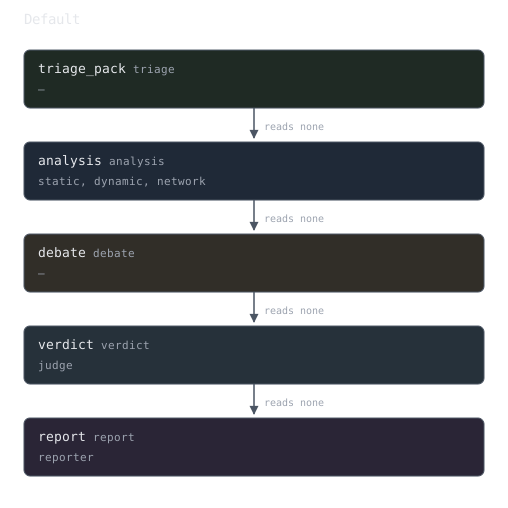
measurement is the same four without the pack, with every tool server
withheld and the static provider forced to none: the baseline for what the
ensemble contributes on its own, with nothing established for it. It is a team
rather than three tool-free clones of the definitions, so the agents it
measures cannot drift from the ones default runs.
mobile is a team for a mobile sample. After the pack, triage reads the
facts it wrote and says which artefacts matter; android_static reads the manifest, the
permissions, the components, the DEX strings and the native libraries, and runs
only when the sample really is one — when: file_type in ("apk", "dex");
dynamic detonates when a sandbox report reached the run. On a PE the Android
stage is still in the graph, still declines and still says why, so the console
shows what the team chose not to do rather than nothing at all.
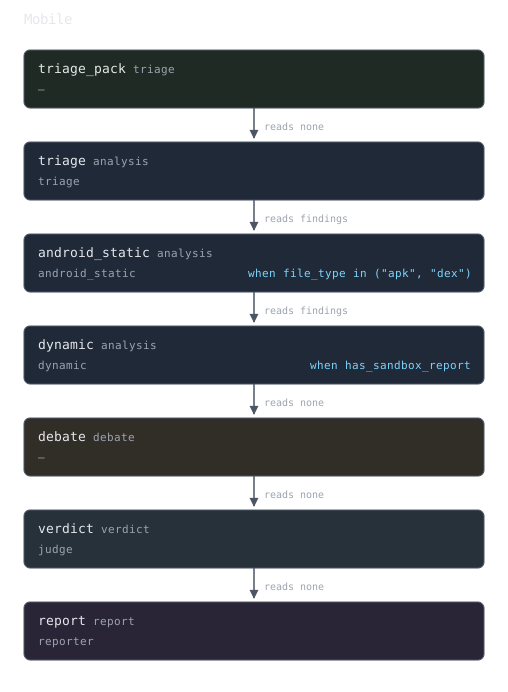
deep_static is a team that reads the code. The pack, triage, then the
built-in static stage, then reversing — a generic reverser agent that is handed
the static stage's findings and asked to confirm or refute each of them at
function level, with the tools of whichever static provider is configured, and
told to mark a finding unresolved when none of its tools decompiles — and
then network, conditional on there being a capture or a sandbox report to
read.
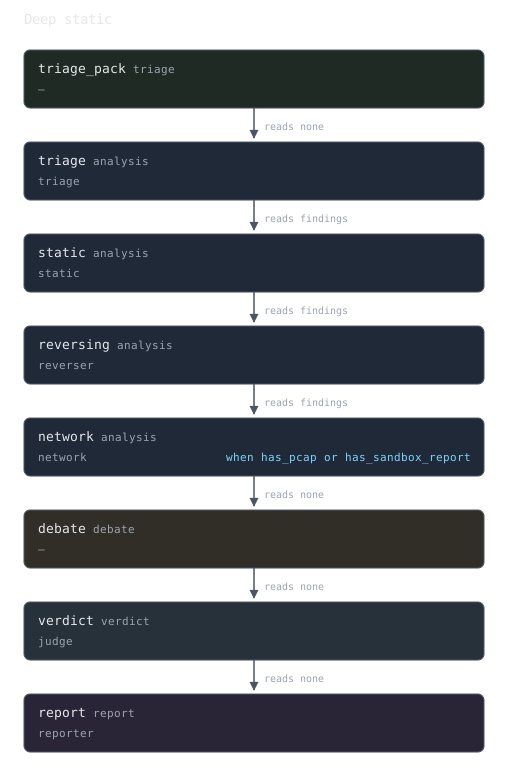
team_lead is a team led by one agent: the pack, then a lead stage whose
only agent is lead, then the verdict and the report. The specialists —
static, dynamic, network, reverser and triage — are the lead's tools
rather than stages, so which of them work on a sample, in what order and how
often is the lead's decision rather than a fixed sequence. Their tool calls are
in the ledger under their own keys and their answers are in the transcript,
addressed to the lead.
It is the one seeded team with no debate stage. A debate is agents arguing with each other, and this team has one analyst: the stage would hand the lead its own report, ask it to revise against nobody, and cost a second full loop — with the asks that loop makes — for a round that cannot change a position. The disagreement happens in the lead's own asks instead, where a specialist that contradicts it does so in the answer it reads.
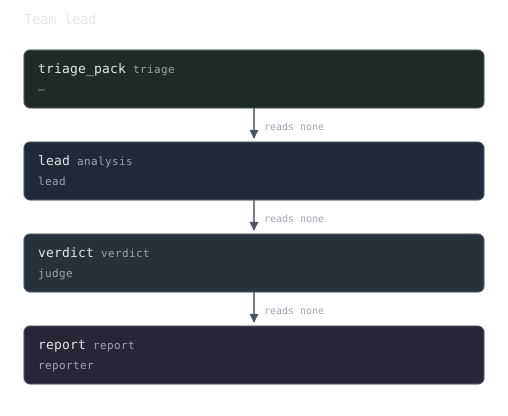
The diagrams are generated from the seeded profiles by
scripts/goldens/render_team_graphs.py, and
tests/unit/scripts/test_render_team_graphs.py fails if the committed SVGs
stop matching the teams, so a stage that moves cannot leave the page behind.
The three generic agents these teams are built from — triage,
android_static and reverser — and the lead are seeded definitions like
any other, with their prompts in src/maljan/agents/prompts/. A generic agent
is a definition and a prompt and nothing else, which is what makes a team
something an operator can write rather than something that needs a class.
Delegation¶
An agent may ask another agent for work the way it calls a tool, because it
is a tool. ToolRef(kind="agent", agent="static") on a definition puts
ask_static in that agent's toolbox, with one required argument task and an
optional context, described from the static analyst's label and role. Any
analyst may carry such a reference — a lead that gives out work, a static clone
that checks a point with the network analyst — and an agent with none cannot
ask anyone, which is what keeps the default team's analysts what they were.
Calling it runs the named agent under the same job: the same container, the
same sample paths (its own provider's mirror first, as a stage agent gets), the
same triage pack at the head of its first turn and the same run-state block at
the end of each request's last message. The callee's human turn is the task, with the context after it
and the claim format it answers in; it runs its own tool loop, its answer is
parsed into claims and checked by the technique check in its own conversation,
and the resulting ISR text — the claims with the ledger ids they cite — is the
tool result, word for word. Nothing between the callee and the caller edits a
claim, a confidence or a technique id (tests/unit/test_no_silent_overrides.py
holds for agents/delegation.py like for everything else).
Everything the exchange did is in the machinery every other tool call is in.
The callee's own calls are ledger entries under the callee's key, handed to the
caller's buffer so the stage node that drains the caller writes them all. The
ask itself is a ledger entry under the caller's key with server="team",
tool="ask_<key>", the task and context as its arguments, the answer as its
output and the callee's wall clock as its duration — so a report can cite the
ask (ev_0012) or what the specialist looked at (ev_0009). The callee's turns
carry a budget of their own (core.agents.delegation_steps,
core.agents.delegation_timeout_seconds, both no limit unless an operator sets
them): the caller's step budget is not spent by its specialists' work, only its
wall clock is, and where the caller's loop has a time limit an ask is cut to
the time the caller has left and refused when that is below what a first model
turn needs. A caller with no time limit waits for a busy callee, unless that
callee is itself waiting, directly or through others, on the caller. A callee that reaches its step cap writes up what it gathered, the
way an analyst at its own cap does — and so, now, does a caller. A lead's
report is the only channel its stage has, so a lead whose own loop ended
without one used to take every answered ask down with it: one audited chunk
spent 1,830 s, collected six answers and 52 ledger entries, and merged zero
claims. The lead is given one bounded turn to write its report from the answers
it already holds, and when that turn produces nothing either the specialists'
own ISRs are promoted into the stage's merge, with their own claims and
confidences untouched. Every answered ask is promoted, in the order it was
asked: a lead asks the same specialist about the imports, then the strings,
then the packer, and those are three answers, so the key carries the agent and
the ask's number (deep_static#2) rather than the agent alone. Nothing is
promoted beside a report that exists. Two agent_message
events carry the exchange, each with stage, round and addressed_to: the
caller's ask, addressed to the callee, and the callee's answer with its claims,
addressed to the caller. The console draws the arrow live, and in the replay
window the events are still in; agent_messages has no column for stage or
addressed_to yet, so a transcript read after the events expire shows the
lines without the arrow until the event model carries them.
What the callee's answer is checked against is the task plus what the callee's
own tool calls returned, read from its ledger entries — which the ledger has
already trimmed to its per-entry cap. A stage agent's answer is checked against
its full data chunk, so with use_claim_consistency_gate on a delegated claim
citing something past that cap is dropped where the same claim in a stage
survives.
Four guards, each a tool error the model reads rather than a job failure. A
callee that is not defined, or is disabled, is refused by name. An ask that
would nest deeper than core.agents.delegation_depth (2: a stage's agent asking
a specialist is depth 1, that specialist asking another is depth 2) is refused
with the chain that reached it; the depth bounds the nesting, never how many
times an agent may ask. An ask back up the chain — the callee asking its
caller, or anyone already waiting on this answer — is refused as a cycle. And
an ask that would come back with a server the asking stage withholds is refused
naming the stage and the servers: a callee's effective tool set is everything
it is bound to — the mcp references on its own definition and the servers
whose agents list names it — narrowed by the tool policy of the stage doing
the asking, so a stage with builtin_tools=False cannot reach knowledge or
network through a colleague that no stage narrows, whichever way that
colleague was bound to them. The settings model refuses the static cases
at save time: a reference to an agent that does not exist, to the definition
itself, to the judge or the reporter, or on the judge or the reporter.
One agent does one thing at a time, on both sides. A caller's asks take its own
lock, so two ask_* calls in one assistant turn — which langgraph gathers and
runs at once — go one after the other rather than putting two nested loops on
one llama-server slot. An ask of an agent, a second ask of it and its own stage
run take its lock, because all three drive the same buffers and the same call
chain. The two are different objects, which is what lets an ask made from
inside an ask still nest. A caller waits for a busy callee only as long as it
can still read an answer in, and one that does not free up in that time is a
refusal like the others. An agent asked twice with the same task is served the
second time and refused the third, by the same repeat guard every tool has.
The stage graph¶
pipeline/builder.py turns a team into a LangGraph workflow and
pipeline/topology.py names the nodes. An analysis stage contributes one node
per agent, <agent>_analyst; a parallel one also contributes a barrier
<stage>__join when its dependents start at more than one node. A debate stage
contributes negotiation and revision, prefixed <stage>__ only when a team
holds more than one debate. The verdict stage is judge and the report stage
is report. A triage stage is one node named after the stage itself. Edges
follow depends_on; a stage with no dependency starts at START, a stage
nothing depends on ends at END, and a debate's way out is the router's
conditional edge — with one rule on top: a triage stage that has no dependency
is where the graph starts, and every other stage without a dependency follows
it instead of START, so a team gains the pack by having the stage inserted
and nothing else rewritten.
A node runs once, after every stage it depends on. In LangGraph, separate
single-source edges into one node are separate triggers: the node runs in the
superstep after any of them finishes. A stage that depends on two stages of
unequal depth — detonation after static and reversing, network after all three
— would run once per upstream stage, and everything after it again, up to two
judges and a report sharing a superstep with the second one. So the builder
enters a node with more than one upstream tail through one list edge,
add_edge([tails], head), which is a barrier that waits for all of them. The
debate's revision → negotiation loop edge and its router stay single-source,
so a loop pass never waits for a tail that already ran. The router's edge is
conditional and a barrier cannot wait on it: a debate whose next stage also
depends on another stage leaves through its own <stage>__join, and that node
is the tail the next stage joins. A stage whose condition declines still runs
its node, so every barrier fills. tests/unit/pipeline/test_every_node_runs_once.py
runs the compiled graph of every seeded team and the all-tools example with
stub nodes and counts.
The default team therefore builds exactly the graph the project has always
built, node for node and edge for edge — tests/fixtures/golden/graph_default.json
pins it in both analyst modes.
A stage's condition never changes the graph. when is evaluated inside the
stage's nodes at run time, so a stage that declines to run is still a node and
still writes a StageResult saying it did not run and why. A topology that
depended on the sample could not be drawn, compared or reasoned about before
the sample arrived. What each stage did lands in state["stage_results"] and
reaches the reader as run_summary.stages.
run_summary.elapsed_seconds is the whole run: the worker's own clock reaches
the pipeline as state["run_started_at"], and the report node closes the
figure when the report is composed, so it is the same span the job row's
duration_seconds measures. The report prints the per-stage durations from
run_summary.stages beside it — the list the console's stage headers are drawn
from — so the two surfaces cannot disagree about where a run spent its time.
Each stage also announces itself live, once: stage_started from its first
node, stage_skipped from that node instead when the condition is false, and
stage_finished from the one node that runs after everything in it is done.
That last node is usually the stage's own — a sequential chain's tail, a
barrier, the judge, the report — and for the two shapes with no single terminal
node of their own, a fan-out without a barrier and a debate that loops, it is
the single node of the next stage. Nothing replays the events at the end, so a
run with reporting disabled still terminates every stage it ran.
An agent whose stage was skipped reaches neither the debate nor the judge: both
read the roster from stage_results rather than from the profile, so a stage
the condition turned off does not arrive as three empty reports. A debate whose
upstream analysis stages all skipped skips itself and says so.
A custom agent runs as a ConfigurableAnalyst with the tools its definition
names. A team may not put one agent in two analysis stages — the node name is
the agent's — may not name the judge or the reporter as an analyst, and may not
name a disabled agent while it is the active team.
Built-in tool servers¶
Every analysis capability the pipeline used to run in-process is also a tool an
agent may call. Four stdio sidecars ship built in, each a single-file FastMCP
server under services/, launched with the same interpreter the worker runs on
and registered in _builtin_servers(). A fifth entry is registered there
without being a process of this deployment at all: VirusTotal's own server,
reached over HTTP and off until an operator registers an agent token.
| Server | Bound to | How | Offers |
|---|---|---|---|
analysis |
static |
definition tools |
Identity and hashes, strings and typed IOCs, PE/ELF/Mach-O/APK structure, archive and document inspection, payload carving, YARA, Sigma, capa and emulated string decoding (FLOSS). |
knowledge |
every analyst and the judge | definition tools |
ATT&CK lookup, validation and ranking, the API-behaviour catalog, the LOLBin table, family and prior-case retrieval. |
network |
network |
role binding | DNS, HTTP and packet views of a capture, plus the whole-capture summary. |
threatintel |
judge |
role binding | VirusTotal and AbuseIPDB reputation lookups over their REST APIs. |
virustotal |
network, judge, triage |
definition tools |
VirusTotal's own MCP server over streamable-HTTP: file, URL, domain, IP, analysis and submission reports. Disabled until an agent token is registered. |
The two tool sidecars carry agents: [] and are bound only by the ToolRefs
in the agent definitions, so the definition's tool list is the single binding
and a clone that drops a reference really loses those tools. Both bindings are
composed the same way for every agent — role-bound servers first, then the
definition's references, under one collision rule.
The implementations live in src/maljan/tools/ as plain functions — explicit
arguments, JSON-serialisable returns, no Settings access — so the sidecar is
a @mcp.tool() wrapper and nothing more, and the same code backs an in-process
caller. Two rules hold across all of them: they report facts rather than
verdicts (a packer section name is a match, not "packed"), and an optional
dependency that is missing costs one tool's answer, never the server.
Each sidecar also answers capabilities: which of its tools need an optional
library, a binary or a setting, and which of those are present on its host,
probed when the server starts. The registry keeps the manifest on the server's
entry when it attaches, the settings probe returns it so the console's server
card names the unavailable tools before a run, and each tool the manifest
marks unavailable is recorded as
server.<key>.<tool>_unavailable(<reason>); <remedy>. A tool marked
unavailable is also kept out of the list the model is given, because offering
one is offering a step that can only fail — unless the manifest says what the
tool still answers without its library, in which case it is offered and the
reason says what is missing from its answer. A tool that cannot answer
returns an error with a code and an authored remediation
(maljan.tools.errors) rather than raising, and the sidecars' guards rewrite
an implementation's flat error into that shape. See Writing a tool server in
configuration.md.
The dynamic analyst's tools are the exception: its sandbox report is already
in the worker's memory, so ToolRef(kind="sandbox") resolves to in-process
tools over that report (src/maljan/providers/sandbox_tools.py) with no
transport to open — the process tree, the network activity, the sandbox's own
signatures, the files written, the registry keys touched, the API-call
histogram, the mutexes held, the services and scheduled tasks arranged, the
platform channels, and a bounded reader for any section the rest do not model.
A tool server reached over HTTP does not share the worker's filesystem, so it is handed the sample rather than a path to it; a stdio sidecar is handed the path. See the remote-delivery section of configuration.md.
The sample's path is not the model's to give. On the three built-in
sidecars, an argument whose name means the file under analysis — path,
file, file_path, binary, sample, target and the rest of
tool_pinning.SAMPLE_ARG_NAMES — is taken out of the schema the model binds to
and filled by pin_paths with the path that server can open. program is not
a path argument on any server: a decompiler names a program in its project with
it (Ghidra: "Program name (default: current program)"), so the name the model
gives reaches the server as it was written. The sidecar's own
signature is unchanged; only the model-facing copy is narrowed, and the
platform's own calls still pass the argument. A qualified path argument —
pcap_path for a capture, a rule file, a member inside an archive or an APK —
names something other than the sample, which is a choice, and stays where it
is. A server an operator added is theirs: this project does not narrow what its
tools advertise.
The correction that preceded it is still there for those arguments, and it was
never enough on its own: it recognises the spellings the model was shown and
the sample's own basename under a directory that holds no such file, and a live
static analyst typed a sample path with three characters missing from the
sha256 in its name, which matches none of them. It then spent its whole step
budget guessing directories — /, ., samples, staging, carved,
uploads, private — and nineteen of that run's thirty-five tool calls failed.
An argument the model cannot see is an argument it cannot mistype.
put_sample, put_sample_begin, put_sample_chunk and put_sample_finish
are the platform's delivery primitive and never an analysis step, so they are
not in the toolbox the model is shown. The same run called put_sample with
{"sha256": "null", "content_b64": ""} and was told, correctly, that the empty
string's digest is not the sample's.
A file an earlier call produced is still the model's to name. Hiding the
sample's path would otherwise have taken the carved payloads with it:
carve_payloads writes each embedded payload under the staging directory and
returns the paths, and with path gone there was nothing left to pass one to.
carved_path is the qualified argument that gives that back, on the fifteen
analysis tools that read a file — identify_file, hashes, signing_info,
strings, iocs_from_file, pe_info, elf_info, macho_info, apk_info,
carve_payloads, archive_list, document_info, yara_scan, capa and
floss. It
is held to the carved tree of the file this call is pinned to, and that file
itself — <staging>/job-<id>/carved/<the sample's sha256>/, which is exactly
the key carve_payloads writes under and which the sidecar derives from the
bytes it was handed. Not the staging base: a base-wide bound let a run read
another run's payload and another run's upload. A sample is adversary-authored
content this model reads, and it can carry another sample's digest in its own
bytes beside one instruction to point a tool at it; samples are not only
malware, either, since an operator submits a suspicious document that may hold
somebody's data.
Staging is per job, and that is what makes the bound the directory rather
than the tree. MALJAN_STAGING_DIR stays the operator's base; the process
that spawns a sidecar composes one leaf inside it per job and passes it as
MALJAN_STAGING_JOB, which the sidecar joins to the base itself — two
variables, because child_env applies a server's own env map last and a
composed path would either lose to the operator's value or overwrite it. The
job's owner removes that directory on every way out of the run, and the TTL
sweep prunes whatever a killed worker left. So put_sample uploads are not
nameable across jobs either, and two runs of the same sample no longer share a
tree.
Both spellings a model writes are understood — the absolute path
carve_payloads returned, and the tail of it relative to this job's staging
directory or to the tree — and whichever it is, the resolved path must land
inside the tree
or on the sample. Symlinks are followed on both sides first, so a link planted
under staging and a climb out of it land where they really point and meet the
existing remediation-bearing refusal. The value must resolve onto a regular
file: a directory, a FIFO, a device or a socket is refused with its own
sentence, because a reader that opened a FIFO with no writer would wait for one
forever. Given, the file is read in place of the sample and the answer carries
read_path saying which; left out, the sample is read.
A quoted search is the same search. A model writes a search the way a
person types one, between quotes, and a quoted needle matches nothing the bare
one would. Every argument a sidecar tool searches for or looks up by is read
without the pair of ", ' or ` that encloses the whole value (the same
character at both ends and nowhere between) — pattern on strings and
floss; text, technique_id, ids, api_names and query on the
knowledge lookups; ip_address, domain and file_hash on threatintel —
by maljan.tools.arguments, with nothing else rewritten and a value without a
surrounding pair passed through exactly. The repair is recorded the way
carved_path's is: the ledger keeps the arguments as the model wrote them, and
a structured answer carries read_as first, the value each argument was read
as (a threatintel answer is prose and names the value it looked up). Each
such tool's description says to give the argument the value itself, and that
a value that is only the parameter's name is asked about, not run — so a
search for that literal word cannot be made; it used to say "pass
pattern as the raw text or pattern itself", and a static analyst sent
"pattern": "\"pattern\"" twice. A call whose argument is nothing but its own
parameter's name — bare, quoted or in a placeholder bracket — is not run and
not written to the ledger: the model is told which argument named its
parameter and asked for the value it meant, the value is never rewritten, the
question is counted under tool.argument_names_its_parameter in
run_summary.validation.by_code, and asking the same again counts as a repeat. Content arguments — the text iocs_from_text and yara_scan scan,
the command lines lolbin_lookup matches — are left as they arrive, because a
command line can begin and end with a quote that belongs to it.
pin_paths needs no rule for it — a qualified name is not in
SAMPLE_ARG_NAMES, which is what the naming rule was built for. A payload
carved out of a carved payload nests under the sample's own tree rather than
opening one of its own, so everything a run produces is the one tree it may
read back and the one tree the staging sweep prunes — which it now does: the
sweep deleted files and skipped directories, and everything carved lives a
level down, so carved payloads never expired at all. No tool extracts an
archive member anywhere today, so a member stays the business of the tools that
already take a member name; when one does, it writes into the same tree and the
same argument serves it.
Providers¶
The provider layer (src/maljan/providers/) puts one interface in front of
each class of external tool, so the choice is configuration rather than code.
- LLM —
openai,anthropic,ollama,gemini. Each has its own credentials, endpoint and model names; only the selected provider is used. Separate model choices exist for the analysts and for the judge. - Static —
ghidra(Ghidra MCP),r2(radare2 MCP),capa_yara,generic_mcpfor a server of your own, andnone. - Sandbox —
mock(the default),cape2,triage,uploadfor a report produced elsewhere, andrest, a mapping-driven adapter for a sandbox Maljan has never heard of. - Tool servers (MCP) — additional servers declared in the settings store, each with the tools it is allowed to expose and the agents allowed to call it.
No sandbox observation where no sandbox ran. mock executes nothing: it
returns a recorded fixture for a sample it has one for (marked
recorded_fixture), and an empty stand-in marked synthetic for any other.
pipeline.sandbox_status reads the run's report once — no report or a
stand-in is not run, a fixture is recorded fixture, anything else is
observed — and every reader says the same thing. Where no sandbox ran, the
triage pack writes one sandbox_status entry with the sentence that says so
([ev_0010] sandbox: No sandbox ran for this sample: …) and none of the
sandbox views, sigma_match_sandbox or lolbin_lookup, so a stand-in's empty
sections are never rendered as "0 processes"; the in-process sandbox tools
answer the stand-in with the same sentence; the dynamic and network analysts
are skipped; the run carries the degradation reason no sandbox ran … (or,
with no report at all, the reason it always had); run_summary.sandbox holds
{status, statement} and the report's run summary prints it; and the entry
becomes the report's Sandbox section, which the console files on the dynamic
tab. A recorded fixture is said to be one — the same entry, then the sandbox
views as before. A live sandbox's report is read as it always was.
Every provider that can be reached over the network has a probe behind a Test button in the console; see configuration.md.
Which agents open a static provider¶
Two kinds, and only two (composition.reads_static_provider): the static
role, whose class opens its provider when it runs, and a generic agent whose
tool list holds a provider reference, whose provider is opened when it is
resolved. Each reads its own provider — the team's forced one, else its
definition's static_provider, else the global one — and the container keeps
one provider object per id. Everything that depends on the provider follows
the agent rather than core.static.provider: the worker mirrors the sample
once per provider any such agent of the team (or any agent they can ask)
opens, so a reverser on Ghidra under another global provider has a path the
Ghidra container can read; the load of the sample and the sink-reachability
pre-pass (providers.static.ghidra.prepare_sample) run for every agent on
Ghidra over http and for no other; and submitting a job checks every such
provider that does not degrade (A team that needs Ghidra waits for it in
configuration.md). A provider that degrades and does not
attach — an r2mcp that is nowhere to be found — lets the static analyst run
without it, and the run summary names it as static provider '<id>'
unavailable: … with the remedy.
When a provider fails¶
A Ghidra that cannot open the job's sample. Before an agent on Ghidra
over http starts its loop, the load of its sample is made once, and the sink
pre-pass reads the program it opened. Ghidra answers a load it could not make
with HTTP 200 and {"error": "File not found: ..."} — the path is one its
container cannot see, most often GHIDRA_CONTAINER_SAMPLES_PATH set to a host
directory — and every call after it answers "No program loaded". So a load
that opens nothing raises SampleNotOpened with "Ghidra could not open the
job's sample: load_program of the held path that
answers with an error is filed on the ledger as a failed call with the
server's words, and the exception ends the loop at once, with nothing
salvaged from calls made against no program. The provider remembers the path,
so no later loop of the job (another chunk, an ask) calls Ghidra for it. The
stage records the agent as failed with the sentence, the run's degradation
reasons name the analyst failure, and the rest of the team runs. An agent that
asked the stopped one reads a failed ask and carries on. Any Ghidra reply of
the shape {"error": ...}, a bare "No program loaded" answer and an HTTP
error are failed calls on the ledger in the server's words.
A load that got no answer from Ghidra at all is a different failure and says
so: "Ghidra at
The load before the loop imports the sample into Ghidra once more than the
model's own load_program does: about a second and a half and one more copy
of the program in the container's memory for a small binary. Nothing closes
the superseded copy yet; a large sample that shows memory growth is where
that would be added.
A model that fails as a provider. An agent's entry under llm.agents may
name an ordered list of models (fallbacks), held as one model object
(maljan.llm.fallback.FallbackChatModel). The next model is asked only when
the one before failed as a provider — a refused or dropped connection, a
timeout, an HTTP 5xx, 408 or 429, a model the server does not have, a refused
credential, or a refusal the provider reports as an error. A timeout is real
because every model on a list but the last has its own turn deadline:
core.llm.fallback_turn_share (a half by default) of what is left, at that
turn, of the budget the loop runs under — an ask's ceiling included, so an
agent asked for help under a shorter clock gets a shorter deadline — never less
than one second. Worked out per turn, so a model that stalls late in a loop is
still replaced before the loop's clock cancels it. The reporter's list starts
over twice per report stage, measured against the narrative round's 600 s and
then against one composer section's core.reporting.composer_per_section_timeout. A model that stops answering raises
inside the list rather than being cancelled with the whole loop (on the
blocking path the abandoned call is left in a daemon thread, so it never holds
up the process's exit); and every provider's client has a request
timeout (1800 s, PROVIDER_REQUEST_TIMEOUT_SECONDS — Ollama's had none) until
the model's pace is measured; then an OpenAI-compatible, Anthropic or Gemini
request whose output cap takes longer at the measured pace carries that time
as its own (generation_rate.with_sized_request_timeout; Gemini's fixed 90 s
is gone). httpx reads a client's timeout as the longest silence, so it only
ever ended an answer on a server that sends nothing until done. Maljan's own
whole-call deadline starts from the same values; where nothing is measured it
bounds only the silence before a call's first generated piece. A call whose
pieces arrive is held to its output cap (or its window's room after the
prompt) at the pace they show from the first to the last
(generation_rate._CallDeadline), and that pace is recorded for the model if
the call does not complete. A llama.cpp server's answer is read as a stream
for this. A 429
or 503 that asks, in Retry-After (seconds or an HTTP date), for at most thirty seconds is waited out on
the same model once before the list moves on. The switch is sticky for the
loop: the model that took over answers the rest of that loop, so a stalled
first model costs one turn deadline rather than one per turn, and the next loop
(the next stage, the next chunk) starts at the first model again. Only the
explicit cause chain of an exception is read, and an HTTP status only from the
provider SDKs' own exception types. A turn a model answered is never moved: an answer the
validation loop rejects goes back, with the feedback, to the model that wrote
it, because asking another model would be the platform choosing a different
answer (tests/unit/test_no_silent_overrides.py holds a case for exactly
this). Every answer carries the model that gave it in response_metadata
(maljan_model) and, when a fallback gave it, the reason in words
(maljan_fallback) — on the turn the list moved, once per switch; that is what
the ledger entry, the model_fallback event and the run summary read. Every model on the list passes the probe gate the first one
does, and the context-window budget counts every model on every list — the
smallest window governs.
What a run spent. Every model call's usage, as the provider reported it —
prompt and completion tokens, and the cost an OpenAI-compatible router reports
where it reports one — is added to the run's TokenLedger under the agent that
made the call and the model that answered. Every path that asks a model
records: an analyst's tool loop (including the turns of a loop its hard cap or
a failure stopped), its revision rounds, a delegated ask, the forced synthesis
and the final-answer nudge under the analyst; the mediator's fast path, tool
loop, reasoning salvage and structured extraction, and the verdict with its
retry, under judge (the mediator's against the expert model it runs on); the
narrative and every composer section, on the structured path as well as the
manual one, under reporter; and the function summariser under summarizer.
A structured call asks for the raw turn beside the parsed answer, because the
parser hides the usage. A call whose answer names no model is recorded under
the model its caller was built on. run_summary.tokens holds the sums
for the run and per agent, and run_summary.models the per-agent model count
and the fallbacks with their reasons. A call whose provider reported no usage
is counted as not reported: its tokens are not estimated, and a figure the
report prints as a count is always a count a provider gave. Each such call is
recorded by the agent that made it, the call it was (tool loop turn,
verdict, mediation, report section, …) and the model that answered, in
run_summary.tokens.unreported, and the token sentence names them beside the
count. Two parts of a
call are recorded where the provider reports them: the input read from its
prompt cache (cached_input_tokens, from the client's cache_read or
DeepSeek's prompt_cache_hit_tokens) and the output spent reasoning
(reasoning_tokens). Each is part of the input or output count, not added to
it, carries the number of calls that reported it, and is absent where no call
did. There is no price table; a cost appears only where the provider reported
one.
A tool server that keeps failing. Each tool server the job's registry
attaches — the built-in sidecars and every operator-configured server — has one
guard (maljan.providers.server_guard), shared by every handle the registry
opens for it. The Ghidra static provider and the CAPE sandbox provider build
their own toolkits outside the registry and are not guarded; bringing them
under it is a recorded follow-up. core.mcp.breaker.failures_to_open calls in a row the server
did not answer — a timeout, a refused connection, the server's process gone, or
a call that did not finish within its caller's budget — rest the server
for core.mcp.breaker.cooldown_seconds. A call made while it rests is not
sent; the platform answers it with a tool error in the structured shape
(maljan.tools.errors, code server_resting) naming the server, that it is
resting and when it will be tried again. A timeout counts: every call is sent
with a deadline — the larger of the tool's budget in the server's own
capabilities manifest and core.mcp.breaker.call_timeout_seconds (derived by
default from the longest tool budget configured, capa's), plus thirty seconds —
and a call still waiting when its caller's own budget runs out counts too.
After the cooldown one call is let through, and a success ends the rest; that
call's own failure is the only one that starts another rest, and only while the
rest it was let through for is still on. A tool that answers with its own error —
a bad argument, a missing file — has answered, and never counts.
core.mcp.breaker.max_concurrent_calls caps how many calls one server has in
flight for one job, so parallel analysts queue rather than pile onto one slow
sidecar. Each rest is published as tool_server_rested and kept in
run_summary.server_rests.
Memory¶
Past analyses and family fingerprints are vectorised and stored in Qdrant, and
retrieved by similarity during a run (src/maljan/memory/). The collections,
the neighbour count and the Qdrant endpoint are settings. The ATT&CK corpus and
its embeddings are cached on disk; on the compose stack that cache is a named
volume, because rebuilding it costs the judge node about a gigabyte of resident
memory and a minute and a half on the first analysis.
The case a run adds to long-term memory, and the function hashes it files
under the judge's family in the attribution corpus, are decided by the judge
and written once, after the job is recorded as completed: the judge holds both
on the container (pending_memory_case, pending_function_hashes), and the
worker, once the completed row is committed and the completed event is
published, calls MaljanApp.remember_the_run, as the command line does once
its run returns. A job that fails after its judge — a later node, or the worker
storing its report — leaves neither, so a verdict nobody kept does not reach
the next run's few-shot prior block or its family matches. The judge builds
the case from the techniques the analysts claimed, before the report decides
which are published; the report node then hands it the published ids
(long_term_memory.with_published_techniques, from report.ttp_mappings), so
the case, §8, the export and mitre.json count one set. Its
total_techniques, its corroborated_count (the kept ids more than one
source named) and its search text (the claims' own words and only the kept
ids, which a later run's attribution reads) follow. The thin-evidence gate —
nothing corroborated and one technique at most — decides on the published set
alone: the judge does not ask it of the claimed set when a report node follows
(nodes.a_report_node_follows), and the report node drops a case thin in
what was published. A run with no report node (reporting.enabled off, or a
profile without a report stage) publishes the judge's bundle, so the judge
moves the case to that bundle's attack-pattern ids and asks the gate of them
(nodes.case_for_the_judge_alone); when the bundle cannot be read there is no
published set, and the case keeps the claimed techniques and the log says so.
The judge still skips a run with failed analysts or no negotiation round. An
id the case leaves out of memory (a claim kept after the absence question, an
id the catalogue lacks) stays out although the run published it. The judge's
log line counts the claimed techniques and says so.
The run summary's stix_object_count is the exported bundle's object count
once the report node has built the export, on the state's summary and on
report.run_summary alike; the judge's own bundle size is kept as
judge_stix_object_count. A run whose export was not built keeps the judge's
count in both.
A cached vector records what produced it, and is reused only by the same
thing. maljan.memory.embeddings has two backends — the sentence model and a
bag-of-words projection it falls back to when the model cannot be loaded, on
an air-gapped install or in a container that is briefly out of memory — and
the fallback projects into the model's own 384 dimensions so the vector
store's schema stays stable. Nothing else tells the two apart: the numbers are
the same shape and the same width. So embeddings.active_backend is the one
fact three decisions read. It is in the cache key, it is in the stored file's
header, and a file whose backend is not the one in use is ignored with a line
saying so — including every file written before the field existed, which is
read as an unrecorded backend rather than as this one.
A run on the fallback writes nothing into that cache and deletes nothing from it. The cache is shared with every later process on the host, and a model that failed to load once is a condition of that run, not of the host: re-embedding costs the run that could not load the model, while a stored bag-of-words corpus costs every run after it and says nothing about itself. The stale-file sweep is held to the same rule — it removes what its own backend wrote and what predates the field, and leaves another backend's file where it is — so a fallback run cannot clear the model's cache on its way past.
The evidence ledger¶
Every tool call an analysis makes is written down as it happens. The tool loop wraps each tool, times the call, records the arguments, the outcome and the result — parsed when the tool answered JSON — and hands the answer back to the model with the entry's id stamped on the front:
The entry holds the answer the model was handed, whole — a second cut here
would make the stored record smaller than the thing the citation points at, and
the one bound on it is the per-agent byte budget, which keeps the call, drops
the output, flags the entry truncated and is counted.
Ids (ev_0007) are monotonic across the whole job. The triage pack's calls
are the first entries of every run that has one, under agent="pipeline", and
the judge's own calls — threat intel on a disputed indicator, a knowledge
lookup — go through the same recorder under agent="judge", so a verdict that
leans on one can cite it. An agent's ask of another agent is an entry under
server="team", tool="ask_<key>", and the calls the asked agent made are
entries under its own key (see Delegation).
Each entry names the model whose turn asked for the call (model, as
provider/model with the endpoint as its scheme and host): an agent may fall
back to another model mid-loop, so which model a call came from is a fact of
the turn and not of the agent's settings. A row written before the column
existed names none.
A call that failed is an entry with ok false whichever way it failed: a
tool that raised, and a tool that returned an error. The entry keeps the
message in error and, when the tool authored one, the remedy in
remediation; run_summary.evidence.failures lists each distinct failure
once with its count and the report header prints that list. The console does
not read that summary — its evidence row shows the message and the remedy
under the call itself, from the ledger entry.
The tool loop also meters itself. budget_tick events carry an agent's steps
against its cap and seconds against its limit every five steps and at the end
of each loop, with its prompt characters and tool_definition_chars, what the
loop's tool definitions weigh with every request (the context budget counts
them beside the conversation); stage_ended_at_cap says which cap ended the work when one did
(steps, time, repeats, no_room, spend — the operator's spend
ceiling — or the triage pack's budget_seconds); and
run_summary.budget sums the spend per agent, with the caps it hit and the
largest tool_definition_chars of its loops, so a
reader learns that an analyst ran out of steps from the summary and the
pipeline panel rather than from a log line.
No loop has a step or time cap unless an operator sets one: the defaults are
None end to end (loop_limits, LoopBudget, langgraph's recursion limit,
the hard cap, an ask's ceiling), and a loop with none ends by its model
answering, by the repeat guard, by its conversation's room or by the job's
spend ceiling (core.spend.SpendMeter, priced from each call's reported
usage), with the arq job timeout as the last resort. Its run-state block says
"no step limit" and "no time limit" in words. Where an operator did set a time
limit, the time cap ends a tool phase the way the step cap and a full window
do: with the salvage writing the answer from what was gathered. The spend
ceiling ends it the same way, for every running loop at once; a loop that
starts after it answers once without tools, and the verdict and the report
still run. It has to end early to
do that, because the thirty seconds of grace past the budget are a fraction of
one turn of a slow model. So the loop times its own turns — from one model
answer to the next, the tools it asked for included — per answering model, and
leaves out the turn on which a model list switched, which holds the dead
model's deadline and not the new model's pace. Once the time left cannot hold
the longest turn plus a reserve for the final answer, it stops calling tools
and salvages. The reserve is 1.5 (the margin the per-call timeouts use) times
the larger of the longest turn and, where the model's generation rate is
measured, a 1,000-token answer at that rate — the size of the slow run's own
final-answer calls, 222 s and 158 s at 3.8 tokens a second — and at least the
salvage's 60 s floor. On a model at about 100 s a turn with one 240 s turn and
a measured 3.8 tokens a second, 1,000 / 3.8 ≈ 263 s is the larger, the reserve
is about 395 s, and the tool phase ends once under 635 s of a 1,500 s budget
are left. The turn the clock ended holds calls that never ran; they are taken
off it, its text kept and the record saying so, because a hosted provider
refuses a transcript with an unanswered call. A model list's turn deadline is
held at the reserve for the final-answer turn, and the answer asked for after
it gets only the time that turn left. A turn longer than any measured can
still reach the budget itself; the loop then keeps what it gathered instead of
aborting the analyst, and the salvage gets what time is left. Either way the
cap is recorded as time; a budget that runs out with nothing gathered says
so rather than naming the hard cap. The hard cap stays the hard cap.
The salvage is sized to finish in the time it is given. It re-sends the
conversation without the loop's tools, so the server reads all of it again
before it writes the answer. Where both of the model's rates are measured —
the generation rate, and the prompt reading rate from Ollama's
prompt_eval_count/prompt_eval_duration or llama.cpp's
timings.prompt_n/prompt_ms, both under run_summary.generation — the
request holds what the time left can read once a 1,000-token answer has been
written, with the same 1.5 margin: 393 s left at 150 tokens/s read and 5.5
written hold about 35,000 characters, where the slow run re-sent 50,000 and ran
into its hard cap on every PE sample. The task and the pack are always kept and
the oldest tool calls go first; when not even the task can be read and
answered in the time left, the salvage is not sent. It never exceeds what the
window allows either, and where a rate is unmeasured the window alone bounds
it. The call is the model's own async one, so its timeout cancels the request
instead of leaving the server generating into the next loop's first turn.
What each salvage sent, how it was sized and how it ended is on the loop's
budget record and in run_summary.budget.<agent>.salvages.
That stamp is what makes a report checkable: the model can cite the call it read
a fact from, a report section lists the entries it was built from, and GET
/api/v1/jobs/{id}/evidence serves those entries back.
How wide the prompt allows. What "too wide" means is not a constant.
preprocessing.max_tool_output_chars is 0 by default, and 0 means the limit is
worked out at the moment of each call from the context window the served model
was found to have, less what the conversation already holds and the room kept
back for the model's own reply, converted at a measured three characters per
token and multiplied by the eighth of what is free that one answer may take.
A positive value is an operator's own cap and is used unchanged. The limit
never exceeds the room that is really left: a floor of 2,000 characters applies
while the room affords it, and when what is left cannot hold an answer at all
the model is handed no answer and one sentence saying the conversation has no
room left — a deterministic fact, with the whole answer still on the evidence
ledger under the call's id. The window is learned free of charge from the
server's own metadata endpoint or from a vendored table — never from a
generation call — and where nothing answered, nothing is derived: the
documented 6,000-character cap applies and every surface says the window is
unknown. run_summary.truncation records which of the four applied and the
smallest and largest cap the run used. The whole arithmetic and the probe are
maljan.llm.context_window; the job's budget travels with every attach the way
the truncation ledger does, the run-state refresher tells it what the loop's
conversation weighs before every model turn, and what it hands out is charged
as it goes so a turn that calls several tools spends one turn's room between
them. See docs/configuration.md for the numbers.
An answer wider than the prompt allows. Before any of that, a tool result
over that limit meets the output guardrail, which
now has three outcomes rather than two. A JSON object is shortened as a
document: elements come off the end of its largest lists, then characters off
the end of its largest long strings, until it fits. No key is ever dropped, the
answer's own truncated flag is set, and one reserved top-level key —
shortened — maps each shortened value's path to what was kept and what was
left out, so a count can be reconciled without reading it against one of the
tool's own numbers that means something else. Nothing else is written into the
tool's vocabulary. Anything that is not a JSON object — a decompilation, any
plain text — goes to the FunctionSummarizer when
preprocessing.use_function_summarizer is on and to the character cut
otherwise, exactly as before. A summary that ended at its output limit, by the
analysts' rule, begins with a note saying its end is missing, and the cut is
recorded with the run's shortened inputs.
The shortening runs before the summariser, and for a JSON object it is the
better of the two: the summariser answers in English prose, and prose is what
leaves the record with no structured at all — which is the defect the
shortening exists to remove. For the decompilation the summariser was written
for, which arrives as plain text, nothing changed. Deciding what to drop is
arithmetic over sizes measured in one walk, it runs on a thread rather than the
event loop, and a monotonic wall backstops it; a document the shortening cannot
help (its keys alone over the limit) is recognised by one subtraction and takes
the character cut at once. Two things bound it: a size ceiling, because the
wall cannot pre-empt the one parse everything depends on, and past the parse a
monotonic wall checked at every phase. An answer this system has already
shortened is not shortened again — a second map would count against a baseline
the first one moved. run_summary.truncation counts the three outcomes apart,
and the wall firing among them — on the job's one truncation ledger, which the
server registry puts on every toolkit it opens, so a bound a tool server's
answer hit is counted where the run summary reads.
What the model is told about it. A shortened answer carries one sentence
for the model: the key the arithmetic is under, that an identical call returns
the identical shortened answer, and this tool's own arguments that reach what
was left out — limit, offset and pattern for strings, nothing at all
for a tool that offers no such argument, which the sentence then says. The
arguments are read off the schema the tool offered
(agents.output_shortening.narrowing_arguments), never guessed per tool, and
the same list is what the repeat notices name, so one tool has one answer to
"ask it differently" however the model arrives at the question. Nothing
re-issues a call and nothing edits an argument: the text is the model's to act
on.
A parameter name is a tool server's own text on its way into the model's
context, so only a plain identifier of at most forty characters is ever named,
at most six of them, in schema order; anything else is left out rather than
escaped or trimmed, because a name this refuses is one the model could not pass
anyway. That bound is also what makes the sentence priceable: both guardrails —
the MCP toolkits' and the Ghidra HTTP client's — shorten to
output_shortening.shorten_target(limit, narrowing), one function, so an
answer and the notice appended to it are together inside the limit the operator
set. The room the sentence may take is capped at MAX_SENTENCE_ROOM, the exact
width of the widest sentence those bounds allow, so a server declaring two
hundred long parameters cannot shrink the budget its own answer is shortened
into. An answer no guardrail saw — an in-process tool's — is not shortened at
all and carries no notice.
The sentence a reader sees is drawn above the section's table, not as a row in it: the bookkeeping is this system's account of its own handling, and a key-value table is a table of facts about the sample. The map's every path resolves in the answer that carries it, and for each one what it says was kept is what is there.
Two bounds keep the ledger from becoming the thing it records. Each output is
trimmed on the way in, and each agent gets a byte budget
(report.evidence_budget_bytes); past the budget an entry keeps its arguments,
its outcome and its timing and drops its output, and the count of what was
dropped reaches the run summary. The ledger lands in the pipeline state as an
append-only list and is persisted with the report, in the same transaction.
An entry that lost its output that way says so with truncated, and the
column is the only thing that says it: a call that failed carries an empty
output too, so a reader inferring the trim from the emptiness explains a
failure with a cause that did not happen. truncated is persisted alongside
repeated_of (the earlier identical call a repeat was answered from), symbol
and started_at, and the evidence endpoint returns all four.
The rows are written in one batch when the run ends, so created_at used to be
the flush for every one of them — thirty entries of one run had one distinct
value between them, and a ledger sorted by it said nothing about when anything
happened. It is now the moment the call returned, started_at + duration_ms,
computed as the row is built. A call the recorder never stamped keeps the write
time, which is honest about being the batch's.
Events¶
A run narrates itself. Every node, every tool wrapper and every retry loop
emits events through one sink (src/maljan/pipeline/events.py), the worker
publishes them (_publish_event in apps/api/app/worker/analysis_worker.py),
and the console draws the running analysis from them.
| Event | Emitted by | Payload |
|---|---|---|
status_change |
the worker | status |
pipeline_started |
the worker | agents, sample_filename, sha256 |
roster |
the worker, once, before anybody speaks | agents[{key, label, role, stages, via}], stages[{key, label, kind, agents}] |
agent_progress |
the worker and the analyst nodes | agent, phase |
phase_change |
the worker | phase |
stage_started / stage_skipped / stage_finished |
the stage nodes | stage, kind, and agents / reason / ran, duration_ms |
agent_message |
every speaking node | speaker, role, round, status, text, kind, and optionally stage, addressed_to, display_name, confidence, claims, dissent, report, report_truncated |
agent_message_delta |
the analyst loop, behind core.events.stream_deltas |
stage, agent, text_delta, and model (the model that gave the turn) and tokens (what the turn spent, when the provider reported it); a turn that only asked for tools is published with an empty text_delta when it carries tokens |
model_fallback |
an agent, on the turn its model list moved on — published whether or not deltas stream | stage, agent, model (the model that answers from here), reason |
tool_call_started |
the evidence recorder | stage, agent, tool, server, args_summary |
tool_call_finished |
the evidence recorder, as each entry is written | stage, agent, tool, server, evidence_id, ok, duration_ms, summary |
validation_feedback |
pipeline/validation.retry_with_feedback |
stage, agent, code, message, retry_index, state, path |
judge_question |
the judge's ReAct loop | stage, text, addressed_to |
budget_tick / stage_ended_at_cap |
the budget meter | see The evidence ledger |
tool_server_rested |
a tool server's guard, when its breaker opens | server, failures, cooldown_s, reason |
enrichment_complete |
the enrichment worker, after the run | report_id, domains_enriched, ips_enriched, similar_samples |
completed / error / cancelled |
the worker | the outcome |
agent_message.kind is one of says, tool_call, tool_result,
validation_feedback, judge_question, verdict, system,
delegation_ask, delegation_answer. An ask and its answer are the last two,
with addressed_to naming the other side, which is what draws a delegated
exchange as an arrow between two participants rather than as two lines to the
room.
A violation is published as retried where the producer is shown it and again
as resolved or survived once the loop knows which; one the retry introduced
is published once. (agent, code, path) is the key those two lines share, so a
reader that draws one line per violation folds on it, and two violations of one
code on different claims stay apart. A finding the producer was never shown —
the judge appends its timeout, its fallback and its two verdict checks after
the loop — is published once, as survived.
Sequence. The publisher stamps every event with seq, a per-job counter
taken from a Redis INCR. Nothing in src/maljan numbers anything: the core
does not know which job it is running under, and a second counter would order
one conversation two ways. seq is the ordering key, the dedupe identity and
the cursor a client resumes from — ?since=<seq> on /ws/analysis/{id} and
on GET /api/v1/jobs/{id}/events return only what is newer, in order.
The stored transcript row carries the payload its event carried: its kind,
the stage it was said in, the addressee of a delegated line and the
display_name its speaker was known by. A replay therefore groups by stage and
keeps the arrow between an ask and its answer, rather than re-deriving a kind
that cannot distinguish the two. A run recorded before those columns existed
carries none of them, and the console falls back to deriving what it can.
The stored transcript row is written with the number its event went out under,
so a live message and its replayed twin are one message. That changed what
agent_messages.seq means: it used to be the message's position within the
report, 0, 1, 2, …, and it is now the publisher's run-wide count, so it is
monotonic and sparse — a conversation of twelve lines in a run that
published four hundred events has twelve numbers scattered through 1..400.
Ordering is unchanged, and ORDER BY seq is still exactly the order the
messages were said in; what is no longer true is that the numbers are
contiguous or that they start at zero. A run recorded before this release
keeps its old contiguous numbers, which still sort correctly among themselves;
because those are a different number from the same run's live events, the
report endpoint sends them as null rather than let a client mistake one for
a publisher number. It tells the two apart from the rows themselves: a
numbered run's largest seq is at least its row count, and the old
enumerate numbering's is exactly one less.
Two stores. Events go to the PubSub channel analysis:{job_id} for the
live fan-out, to the Redis stream analysis:{job_id}:events (1 000 entries,
24 h), and to job_events against the job, written in batches of fifty events
or two seconds. The table is what makes a failed or cancelled run readable: no
report is written for one, so before it the whole conversation vanished with
the stream. Both readers ask Redis first and the table second — when the
stream has expired, and when the cursor is older than the capped stream
reaches. core.events.retention_days (default 30) bounds the table; the
worker sweeps it nightly. The transcript, the agent findings and the evidence
ledger are kept by the report and the job and are not touched by the sweep.
The count is the last number. Every event takes a sequence number from the
run's counter, so the rows stored for a job equal the last number issued for
it — that is what the events endpoint pages by and what the console checks its
history against. enrichment_complete is published after the run has ended,
by the other worker, so the enrichment task opens the job's feed for that one
line and closes it again; otherwise the number would be issued and the row
never written, which is what one measured run's 71 published and 70 stored
was. The console already tolerates an event that arrives after the run.
The counter itself is a Redis key with the stream's 24-hour life, and the rows
outlive it by core.events.retention_days. So before that late event is
numbered, the counter is seeded from the table — the highest seq the job
holds, set only when Redis has none — and the number continues where the run
left off instead of starting again at 1 and colliding with the row that has it
(uq_job_events_job_seq). Enriching a month-old report is exactly that case.
What never travels. Tool arguments and results go out as short summaries,
and every string of every event — a message's text and its report, a
correction, a cap's detail, a summary — is scrubbed once by the publisher, for
all three sinks at once: anything shaped like a credential is replaced, a URL
keeps its scheme and host only, and every path is cut to its file name. A
Windows function name the vendored export-name catalogue holds, one this
job's hash resolution on the analysis server read, or a hash-algorithm id of
the vendored algorithm catalogue, is a name and travels as written, as it does in the
report (docs/configuration.md, "Long agent keys in the conversation"). A
producer may scrub as well; the publisher is what makes it a guarantee rather
than a habit, and the transcript's copy is scrubbed as it is taken, so a
replayed run reads exactly as the live one did.
The fields that name something rather than say something are exempt, by
field name (analysis_worker.IDENTITY_FIELDS): the ids this system issues
(report_id, job_id, sample_id, error_id, evidence_id,
technique_id), the agent, stage, server and tool keys (speaker, agent,
agents, addressed_to, stage, stages, via, server, tool, key,
profile), the labels an operator typed (label, display_name) and the
words the console switches on (role, kind, status, phase, cap,
code, verdict). Nothing is exempt for the shape of its value beyond a
digest and a canonical UUID, because a credential does not become safe by
being lowercase.
A failed call travels as the remedy the tool offered, not as its error text, and a failed node travels as the class of its exception, never its message. The arguments and the output as they were are on the ledger entry, behind the same ownership check as the report.
Names. roster carries the label an operator gave each agent, and GET
/api/v1/jobs/{id} carries the same roster, so a reader who is not an admin —
and cannot read the agent definitions through the settings endpoint — still
sees "Lead analyst" rather than lead, on a live run and on a finished one.
The findings block¶
An analyst may end its answer with a fenced maljan-findings block holding
JSON: artifacts (a kind, a label, and either a value or columns and rows) and
findings (a title, techniques, a confidence), each naming the ledger ids it
came from. It is optional in both directions — an analyst that emits nothing
loses no claim, and the CLAIM/EVIDENCE/CONFIDENCE/TECHNIQUE contract the
negotiation runs on is untouched. What the block adds is the table a claim
cannot carry: the import list, the permission set, the endpoints.
Anything that fails validation is dropped and counted rather than repaired, and the block is stripped before the prose reaches the transcript or the report.
A repeated tool call is a message to the model and nothing else. The third
identical (tool, arguments) call in one loop is not run; the model is told
which entry already holds the answer, and whether that entry was an answer or a
failure. Nothing is written to the ledger for it and nothing is drawn in the
console: no tool ran, and recording it as a successful call — which it was —
inflated the ledger, the report's tool-call count, and gave the model an
evidence id it could cite for evidence that did not exist.
Reporting¶
Every run emits a structured MalwareReport (src/maljan/reporting/), and it
is assembled from what the run gathered rather than recomputed beside it:
reporting/ledger_report.pyturns the ledger intoreport.sections— a builder per known tool, generic fallbacks (a JSON object becomes a key/value block, an array of objects a table, anything else a capped text block) for a tool nobody has written yet, the agents' artifacts grouped by kind, and their findings as one table. Every section carries the entry ids behind it.reporting/ledger_projection.pyfills the typed blocks —static,dynamic,network,persistence— from the same ledger, because several layers still read them. A tool that was never called leaves its block empty and every layer downstream of it degrades to silence.- Identity comes from
identify_fileandhasheswhen they ran, and from the routing minimum (format, platform, and hashes the builder computes) when they did not. - Severity, malware category and family attribution are the judge's, read off
x_maljan_assessmenton its bundle. Nothing in the builder computes a replacement — the CVSS-shaped sum that used to print a score out of ten was arithmetic over constants chosen in the builder, by code that had read no evidence. - The capability matrix is a projection of the judge's technique list and the
analysts' claims, carrying each source's own confidence unadjusted. A judge
relationship's technique is the attack-pattern it points at
(
x_maljan_technique_idwins where written, which the judge never does), so the number the judge put on it is the judge's number; reading the property alone published all twenty judge-only techniques in the stored runs at 0.0. A relationship with no number adds none, and a number off the 0–1 scale is no number (stix.annotation_out_of_schemaasks about it; the annotation is kept as written rather than lost to a plain relationship). A technique no source numbered hasconfidence: nulland is printed "not given" — the case for every technique the judge names alone under a verdict with no malware object to hang a numbered edge on. A technique'scontributing_layersare the judge and the analysts whose own claims name it: the agents a judge relationship credits are its words about the evidence, published on the relationship and not counted as sources, so one analyst's claim the judge credits to two analysts is not corroborated. A credit is still asked about when it names an agent that did not name the technique: the judge node passes the evidence summary as data (evidence_summary.collect), andstix.credit_without_claimtells the judge which sources did name it, by the summary's names — a parent or sub-technique counts. Nothing rewrites the credit in the judge's bundle; one the judge keeps is left off the export's copy of the relationship and recorded asstix.unpublishable_credit, so no surface prints it. A technique the judge names and no analyst claims is the judge's own claim: asked the catalogue and platform questions every claim is asked, and published with the judge as its source and the judge's own number. Its ATT&CK row says so ("stated by the judge and claimed by no analyst; a technique the judge states is published as its own claim"), so a row with no analyst beside it reads as the rule it is published by and not as a gap. When analysts named it on a finding and no claim carries it, the row names them instead ("stated by the judge; named on a finding, not on a claim, by …"), since the run's corroboration record lists them as its sources. Corroboration counts independent statements (capability_matrix.independent_statements): each analyst statement naming a technique is compared by its normalised text (case, markup and punctuation out). Two count once when they are the same text, when one is inside the other word for word, or when at least 90% of the shorter one's words are in the other (the overlap coefficient over their word sets,REPEATED_WORDS_SHARE): a copy cut short or with a word put in or taken out is one statement, and two analysts' own sentences about one tool's output stay two. The repeat is the shorter of a pair: statements are read longest first (word count, then normalised text, then layer) and each is compared with the ones already kept, so each group is credited to the layer of its longest statement and a short statement can never absorb two longer ones that share only its words; the count does not depend on the order the analysts are read in.is_corroboratedis two layers credited so (independent_layers). The row says how many statements were identical or near-identical (identical_statements); a row fewer than two layers stand behind that way prints "not corroborated (N analyst layers name it; K of them in a statement of its own; …)". A finding's detail is a statement and its procedure, and its title is neither: an analyst's one summary title was listed under five techniques. The console's badge and the narrative prompt (independent=) read the same list. A knowledge-table rule that matched only names resolved at runtime (every matched name in itsresolved_apis) is named as a source "rule match on names resolved at runtime from hashes only, no import; not counted as corroboration", and under the table each analyst statement naming its technique is printed verbatim, by analyst (CapabilityCell.statements); the platform classifies none of them. The ELF run creditedSTATIC ANALYSTwith T1490 and T1048.001, which no source named. A bundle the pipeline built from the analysts' claims because the judge's answer was not one credits those analysts, not the judge. A technique id is read only from a reference filed under MITRE ATT&CK (analysis.technique_ids.attack_reference_id). It is where an id the ATT&CK check rejected stays on the record, markedtechnique_id_valid=Falseand spelled as the producer wrote it. Every id that reaches the report is collected into it, from all three carriers: the judge's attack-patterns,claims[].technique_id, andfindings[].technique_ids— the second place an ISR keeps technique ids, and the one no check ever saw. A recorded Android run's final ISR carried one claim with no id at all, so no domain check fired anywhere, and the report's Findings and Corroboration tables printed three enterprise-only ids with nothing saying they were not published. Every id still standing is asked the catalogue question here as well as the domain one, so an id that arrived on a finding gets the same answer an analyst's claim got in its own loop. ttp_mappingsis the published technique list, and every other technique surface is built from it: the report's ATT&CK section, its References, theattack-patternobjects of the STIX bundle — minted with ids derived from the technique id, so the same technique is the same object across exports — and themitre_techniquescolumn behind/reports/{id}/mitre. What the judge said about a technique travels with it: its relationship, with the confidence, the evidence basis and the contributing agents it annotated, is re-linked at both ends to the rebuilt object of the same technique and carried unedited, and the rebuild mints no secondusesedge for a technique the judge already used. A relationship to a technique the checks rejected is removed with that technique and recorded inrun_summary.validationasstix.unlinked_technique— counted once, as the technique's loss, and not again by the integrity pass as a dangling ref. Two checks keep a technique out of the published list, and both write their reason intoCapabilityCell.not_published, which the markdown prints under Claims that were not published as techniques: an id the catalogue has no entry for, and one whose ATT&CK domain or platforms the routed sample cannot host (attck.platform_mismatch, asked with the sameplatform_mismatch_messagethe analyst and the judge were shown, and falling open for a sample whose platform is unknown or cross-domain). The judge has the last word on what it did not name. After the verdict the judge node asks the judge once (JudgeAgent.decide_techniques), in one tool-free question with the verdict's framing and sizing, about the techniques an analyst claimed that its bundle carries on no attack-pattern and no edge, the ones named only on a finding, and the ones every claim naming which the ATT&CK check says does not describe it (validation.claim_does_not_describe_violation) — carried by the bundle or not, asked once either way with the check's finding under it (undescribed_technique_finding) — (capability_matrix.judge_questions), each with the claim or finding text and its evidence ids: keep or drop, with a reason. The check is asked as the analysts' check asks it (claim_asked_whether_it_describes: not of a claim that reads as absence, or whose id the catalogue does not know or the sample cannot host), and its finding is stated as the term match it is: no claim naming the technique uses the catalogue's terms for it. The review keeps each finding it asked with (undescribed), and the row prints it beside the judge's answer and reason. Each id is named as the vendored ATT&CK table names it (attck_loader.technique_label), in the list, in the techniques the question says the bundle carries and in the evidence summary: asked about bare ids, a judge dropped a Winlogon Helper DLL id as "Scheduled Task/Job". Every technique name the platform writes comes from that table, the reference the export back-fills on an attack-pattern included. The question shows what it asks the judge to decide from — the analysts' reports as the verdict call sees them (verdict_reports_text), the verdict and the techniques the bundle carries, and the text of every cited evidence entry — and when the entries do not fit the judge's window less its output cap, each is shortened to an equal share with the cut marked, a notice in the question, and the notice recorded on the answer (shortened). The answer is asked for as a JSON array, read from the schema where the provider has structured output and otherwise byread_technique_answer: JSON arrays and objects first, then each line on its own (table rows, a name after the id, arrows, a "Decision:" label), a<think>block taken out and the last answer per id kept. The decision is read from its position — a JSONdecisionof one whole word, or the word straight after the id's separator, else the last standalone keep or drop — never from a word in the reason. Each cited entry is shown as stored (question_evidence), with its tool, and marked when the run holds only part of it or only its lower-cased search copy. An id the catalogue rejects or the sample cannot host is not asked and is recorded innot_asked. The answer is kept on the judge's bundle (x_maljan_technique_review, never exported) and the matrix publishes per it: a dropped technique is not published and reads "the judge dropped it ()", a kept one is published — a finding's technique included — with "kept by the judge when asked ( )" on its row. With no answer — the question timed out or failed, the verdict itself timed out, or no line of the answer is in the form asked — nothing is withheld: each technique is what it would have been without the question, and a published one is marked "not confirmed by the judge". An APK run published enterprise-only T1027andT1005on all three surfaces with both mismatches unresolved; they are in the matrix, with the reason, and on none of the three now. The check's own carve-outs decide what survives, andPREis the one that matters most now that the answer is read to publish by: a technique whose only platform isPREhappens before any host is touched, so nothing about a sample contradicts it — including its domain, which is why that carve-out is asked before the domain comparison. ATT&CK files every PRE technique in the enterprise matrix and mobile has none, so asking the domain first made each of them cross-domain on an APK and would have takenT1583 Acquire Infrastructureoff an Android infostealer's C2 registration. Anisr.ungrounded_techniquealone is not one of the two: it is advisory, and the technique is published and flagged. The three surfaces used to be built from three sources and disagreed inside single runs: ten techniques in one report against zero attack-patterns in its bundle; three attack-patterns with no ATT&CK reference and ids copied out of the STIX documentation against an emptyttp_mappings; a rejected id published in all three.- Every surface that prints a technique id says whether the run published
it. The markdown's ATT&CK section names the unpublished ones under Claims
that were not published as techniques; the Findings table writes
T1027 (claimed, not published)in its Techniques column; eachrun_summary.corroborationrow carriesnot_published, written by the report node from the capability matrix's own reasons, and the tables print it throughtechnique_label; the run summary's own line counts both — "3 claimed, 0 published", because "3 named" over a run that published none of them reads as three findings. An id in neither the published list nor the matrix's reasons — dropped by its analyst in revision, so no check was ever asked about it — says exactly that. The console's ATT&CK tab draws fromcapability_matrixrather than fromttp_mappings, so a claimed-and-unpublished technique appears there too, with the words claimed, not published and the check's sentence under them rather than a colour. - An attack-pattern with a name and no technique id is asked for one
(
attck.missing_id) — before this it skipped every ATT&CK check, because all of them key on the id, which is why the Mobile-domain check never ran on an Android sample's techniques. One that survives is reported as a behaviour, inreport.unmapped_behavioursand under its own heading in the markdown, and is never published as a technique. run_summary.evidencecounts the calls andrun_summary.sections_without_ evidencecounts the sections that can name neither an entry nor a finding — the number that says whether the report is standing on anything.- The section-wise composer shows each section the exact JSON object it has
to answer with, built from the section's own schema so the prompt and the
validator cannot drift. This is the manual-parse path, which is the primary
path on a local server — structured output is skipped there — and on it the
prompt's own rule said "conform to the provided JSON schema" with no schema
provided: the only key name a model ever saw was the bundle's opening line,
and that line read
SECTION: <name>. Two unrelated models answered six runs out of six withSECTION/contentor with the section's own name as the key, and every one of those runs authored zero sections. The heading is a sentence now. - One shape the models produce is accepted as a move rather than a guess:
{"<section name>": "the prose"}, where the key is this section's own name and the value is a string, is put into the field that holds the section's prose —textwhen the schema declares one, otherwise its single string-typed field. A schema with several (a ransom note, an encryption scheme) or none (a channel list) has no such field and is left alone; so is a renamed key, a second key, or a value that is not a string. Anything not accepted is dropped and named, as before. - The composer keeps the fields a section's schema declares and drops the ones it does not, rather than refusing the whole section over an invented key — which is how two runs shipped with no conclusion. What it dropped, and any section it lost outright (still off-schema after its retry, timed out, or failed), is added to the report's degradation reasons, which the header points to under Notes on a run that is not otherwise degraded. The same goes for a list the composer caps (the flow at 20 steps, the configuration at 30 items, the commands at 40, the flags at 30, the channels at 6): an answer past its cap leaves "report section '…' was trimmed: the report keeps the first N of the M items the report model wrote".
- A missing parser degrades a run only for a sample of the format it parses:
the pack skips
macho_infoon a PE, and a server's…_unavailablereason about a format tool the sample does not need is not added to the judge's degradation reasons. - The rendered report reads as a vendor's malware analysis, in three
labelled voices. The Markdown — and the HTML and PDF made from it —
follows one numbered layout: a title block naming the family and category
when the judge named a family, with the TLP, the report number and the date;
§1 key findings; §2 sample overview; §3 verdict and assessment, with the
judge's rationale quoted unedited; §4 execution flow; §5 technical analysis
by capability, each subsection's prose followed by the measured or observed
tables that prove it; §6 observed behaviour; §7 static properties with the
rule hits; §8 one ATT&CK table with procedure, source, confidence, status and
evidence columns, the import-table rules among its rows; §9 the indicators;
§10 detection; §11 recommendations; §12 attribution with the similarity
scores and the background; §13 limitations, where the tool failures, the
evidence bounds, every unresolved finding and the export decisions are said;
and four appendices — the evidence index with every ledger section, the run
summary, the references and the methodology. Every H2 ends with its voice, one
of nine tags (
renderers/markdown.py:VOICES): Measured, Observed in sandbox, Assessed, Assessed by the judge, Written by the report model, Generated by template, Source per row, Source per subsection and Reference; a section of several voices tags each subsection, and a §5 subsection holding both the report model's prose and a measured table is tagged Source per row and labels the prose the way each table is labelled rather than being split in two. A confidence is printed as a number, a fixed word for it and its producer — moderate-to-high confidence, 0.86, stated by the judge — the word a deterministic reading of the number (≥ 0.90 high, 0.70 moderate-to-high, 0.50 moderate, 0.30 low, below that very low) and never printed alone. Model prose ends with its citations, or with no evidence cited and one sentence saying to check it; the renderer adds tags, citations and words around the model's text and changes none of it. Every numbered section, every §5 subsection and the §10 and §12 subsections are printed; one with nothing in the run prints one line in the platform's voice that says whether nothing was found or nothing looked, naming what did look — "Nothing recorded in this run: the tools that ran over the file (capa, yara_scan, …) recorded no discovery command, and the sandbox recorded nothing for this sample; the report model wrote nothing on it", "Not written in this run: the report model wrote no execution flow"; "Not examined" only when no tool looked at the file at all — and the table subsections of §6, §7 and §9 are unnumbered headings that appear only when they hold a table. An absence is said only for what a tool looked at: "no persistence observed" only when a sandbox recorded the host (a dynamic block whose registry and file operations it provides), with the failed and trimmed entries named when the evidence was partial, and "No sandbox observation is recorded in this report." for a stored report that cannot say. The numbering is fixed, so a comment can cite §7 whichever sections a run filled. - A degraded run's first screen is one sentence. The header builds it from the stage and agent records — the failed-analyst list, each analyst's recorded skip reason or no-data flag, its claim count — and the sandbox's state: "The static analyst failed, the dynamic and network analysts were skipped (no sandbox fixture for this sample) and the sandbox recorded nothing for this sample; the verdict above is tentative. See §13 for what this run could not examine." It never prints a reason code or an operator's install command. §13 lists every degradation reason verbatim, with its remedy where the reason carries one, and prints each analyst's state under What ran. A run that is not degraded but recorded limitations points to §13 in one line. §3 does not claim consensus among analysts that claimed nothing.
- Every number printed has an owner. A technique confidence prints with its
producer ("high confidence, 0.92, stated by the judge"), read from
CapabilityCell.confidence_source, which the matrix sets to the source of the highest number; a stored cell without it says "producer not recorded". A confidence nobody stated prints "not given"; a packer match, a function-hash match, a similarity candidate or a carved payload with no value prints "not recorded", never 0; a similar sample the long-term memory returned without a distance is counted and not listed ("No similarity measure was recorded for these samples."). A finding an analyst wrote without a number carries none (Finding.confidenceisNone), and the matrix records neither a number nor a producer for it. The sample's reputation lookup is one measured sentence in §2 ("VirusTotal: 52 of 75 engines flag it as malicious"), from the engine countsledger_reportlifts into rows. - A model's table is never a measured row. The import table, the string
table, the process tree and the persistence mechanisms are projected from
tool output only (
ledger_projection.static_from_ledger,dynamic_from_ledger,persistence_from_ledgertake no analyst reports); §5.2's import count, §7's import table and capability profile, §8's rule matches, the IOC table, the corroboration corpus and the detection drafts read them. One run's analyst listed names it had resolved from hashes asKERNEL32.dllimports, and the report counted 23 imports against the tool's 5 and matched rules on them as imports. An analyst's table of imports, IOCs, processes or persistence stays in Appendix A under its kind, with a line naming the analysts who listed it (markdown.analyst_list_note, from the section'sartifact:source) and saying no measured table, count, rule match or capability profile reads it. Appendix A is tagged Source per subsection: each of its sections carries its own voice, Measured for a tool's answer and Assessed for an analyst's table or findings, so no model's rows sit under a Measured tag. A kind more than one artifact listed rows under is one table whose first columns (Listed by,Evidence) say which analyst listed each row and the ids that row's artifact cites, and the note says where else the table's rows are shown; the §5.4 Assessed block cites each row's own ids. The body still shows them as the analyst's. §5.4 keeps the tools' table and adds an Assessed block of the persistence the analysts listed (Kind, Target, Payload, Listed by, the evidence the table cites), read from the analysts' Appendix A tables (ledger_report.analyst_persistence), never frompersistence; the narrative is handed it as its ownpersistence_assessedfact. The IOC table carries each mutex, path, registry key, scheduled task and service an analyst listed (ledger_projection.listed_non_network_values) as ananalystrow, "listed by theanalyst", with the rule's refusal, after every tool row, and not where the judge names the value (the judge's row answers it). A row of any kind only an analyst listed is listed-only to the rule, so it publishes nothing. - The proof sits beside the prose. §5.1 and §5.2 print every capa rule the run recorded in the anti-analysis, obfuscation and encryption namespaces, and in the runtime-linking, PE-export, hashing and checksum namespaces (with the PEB-access rule), with the capa section's evidence ids; a rule that speaks to resolution is printed there once, not in both. In §8 a rule naming a technique a row already holds is folded into that row's Procedure and Evidence; a technique only rules named is one row with the catalogue's tactic and name and the status "not published: a rule matched it and no producer claimed it".
- A list item, a step and a heading are built by one helper each.
_item,_stepand the heading helpers flatten a value onto its line, and model prose cannot open a heading (ATX, or setext through a line of=or-), a code fence or a table (a delimiter row is escaped); fenced blocks use a fence longer than any backtick run inside them.test_a_list_item_is_never_assembled_by_handfails the build if a string literal elsewhere starts a bullet, a step or a heading, as the table guard does for rows. - Who is speaking is who spoke. The platform's "No summary was written" fallback is headed Source per row with a voice per line; the platform read from the file format is a Measured row of §2, not the judge's; §12.1 is tagged by who named the family (the judge, the sandbox's classification as Measured, or Assessed when a stored report does not say). The title names a family only when the judge named it with evidence ids. The report model's unresolved findings print under §1. The HTML anchors and contents are the section titles alone, so a link does not change with a voice tag.
- Network indicators are defanged for reading, by their kind.
reporting.defang.defang(value, kind)writeshxxp://,hxxps://andfxp://with the host's dots bracketed,[.]in names and IPv4 addresses,[:]in IPv6 and[@]in mail addresses; a hash, a path, a registry key, a mutex, a pipe, a user agent and a command come back unchanged, soupdate_data.datis never bracketed. The same rule reaches model prose and the evidence dump throughProseDefanger, which touches exactly the values the run's network block and IOC table hold, as whole tokens. The JSON report, the STIX bundle, MISP and/reports/{id}/iocscarry every value live, and the indicator section says so under its tables. A §7 string is printed as the file's bytes are, and says it is not an observed endpoint. - A sandbox row is the sample's when the sample's process tree made it.
The Triage mapping carries each flow's
procid,pidand AS facts into its tcp/udp row and statessample_process_tree: true when the flow's process is the sample or a descendant of it throughprocid_parent, false when the report names another process, absent when it does not say. The sample's processes are read from two facts: the processes Triage marksorig, and the processes that run a file whose name equals the submitted name or is the sample's digest with an extension — equal, never contained, so a guest'sMicrosoftEdgeUpdate.exeis not a sample submitted asupdate.exe. Each fact gives a tree throughprocid_parent. Where both name processes, a process in both trees is the sample's (true), a listed process in neither is not (false), and one in exactly one tree is disputed: the facts disagree, so its attribution is absent and the row says which fact alone named it (lineage_disputed:origorfile). Where only one fact names any process, its tree is the answer. A flow outside the tree or disputed carries the image of the process that made it (process); the address's row states those processes (outside_processes,marked_only_processes,file_only_processes, as<image> (procid N)), and the publish rule'sno:and the IOC table's context name them with both facts. A disputed row, like any unattributed one, is published only when the judge keeps it after being asked once with the sandbox's fact: the verdict's own question names each judge indicator on such a value with the fact beside it (validation.unattributed_indicator_violations, the facts read bynodes.judge_sandbox_factsfrom the network block the report is built from), and a keep after that question is recorded answered (stix.indicator_unattributed_flow,answered: true,subjectkind:value). The publish rule reads that answer (stix_renderer.sandbox_row_kwargs): the row's reason states both the keep and the sandbox's fact, and a judge's keep it was never asked about publishes nothing and says which case applies: the judge wrote the value in its last answer and no turn was left to ask it, or no question with the fact is recorded for this run (a report stored before the question, or a verdict with no readable network record). A judge URL is asked about its host, the value its keep stands on, and a URL row on an address says the judge kept, or named, its address. Every published row says why, on every surface: the IOC table'syes:reason,/iocs'publish_answer, the end of each exported indicator'sdescription("Published because: …") and a comment beside each value in the YARA and Suricata drafts. CAPE, REST and mock reports carry no process on a flow, so every address they record is unattributed and is published only when the judge keeps it. The network block is projected from the job's whole report, never from a paged view; the in-process sandbox views answer every row and page on request, and their answers go through the MCP toolkit's own guardrail (ServerRegistry.answer_sizer: the job's limit and ledger, the context budget charged, a JSON answer shortened as a document whose notice namesoffsetandlimit), and an address somebody watched is kept whatever its class and answered withno:when it cannot be published. The sandbox view marks public DNS resolvers, and the network block carries the attribution, the resolver fact,kept_by(the analysts whose artifact lists the value) andmentioned_by(an analyst's claim holding the value). A value is listed by an analyst's artifact (ledger_projection.kept_network_values) of a keeping kind only —endpoints,network,iocs,c2and their plain spellings (network_iocs,c2_endpoints,indicators); a table of contacted hosts is an observation and keeps nothing. A row has one type cell: the column a heading namestype, or else the first short cell (at most three words; a longer one is a note) naming a type, read by its last word with a:porttaken off ("C2 domain" isdomain, "ip:port" isip). The type applies to one value cell — the heading's value column, or the cell after the type cell, or the one before it when the type comes last or the cell after it is no value of that type — and a network type (ip,ipv4,ipv6,address,domain,host,hostname,fqdn,url,uri) keeps that value. A row whose type cell is a file, a path, a mutex, a registry key, a hash or anything else keeps nothing; a note cell never drops a typed row. Every other cell is read untyped, and only in an endpoints or C2 list: an address is kept, a name only when it could be a host and has no file extension. A name the model typed as a domain, host or URL is kept as written, whatever its TLD (.zip,.movand.appare real ones). The value is read tolerantly: a port taken off, IPv6 brackets, any case, a URL's host. The judge's URL indicator keeps its host the same way. A well-known benign host is kept only as itself, never through a URL on it.FINDINGS_BLOCK_FRAGMENTstates the shape it asks for (ENDPOINTS_ROW_SHAPE). The publish rule (stix_renderer.sandbox_row_kwargs, asked throughemulation_kwargsby the table, the export,/iocsand the judge's values alike) holds back a sandbox address the tree did not make, and a well-known benign name the guest resolved — Windows resolves through its DNS service, so a name is judged by what it is — until the judge's indicator keeps it. A model's list never overrides what the sandbox says about a value. An analyst's artifact listing the value is named in the reason and publishes nothing (one run's endpoints artifact published every conversation the guest had, the public resolver included), and a claim that mentions the value keeps nothing (one run's analysts named two background addresses in claims calling them noise). The row readsno: <reason>, and no model kept it as an indicator, or, when an artifact lists it,no: <reason>; <artifact> lists it, and a listing does not change what the sandbox recorded about it; the judge did not keep it as an indicator, naming any claim that only mentioned it, with the AS fact in the reason and the table's context. A public DNS resolver is never published, whoever lists or names it, the judge included: the reason states the sandbox's fact, that it is a public resolver and who listed it. A sandbox URL whose host is an address takes that address's row facts: it waits for the judge when the address is unattributed, and a resolver's URL is never published. A value's standing comes from where the platform saw it. The capture (pcap_summary) is a sandbox view like the flow table: its conversations' addresses and its TLS names are sandbox rows, with no attribution. A name only the capture's TLS list recorded, which no DNS or HTTP view names, iscapture_onlyand readsno: a TLS name only the capture recorded, which does not say which process made the connection, and no model kept it as an indicatoruntil the judge keeps it; a name a DNS or HTTP view also names keeps the name rule. A row the sandbox view holds is decided by the sandbox rule above, a row a tool read out of the file (the string sweep, a recovering tool) by that source; a listing never lifts a row a tool recorded (ledger_projection._DOMAIN_SOURCE_RANKranksanalystbelowstrings). Every value an analyst lists is looked for, whole, in every tool answer of the run at build time (ledger_projection.tool_sightings, stored astool_sightings, keyed on both sides withledger_projection.value_key, so a bracketed or capitalised address is found). An entry whose call arguments hold the value is no sighting of it: a lookup's answer repeats its question, and a search returns the match it was asked for. Such entries are kept apart (tool_queries), and a value only they hold readsno: named only by an analyst (<artifact>); only the answer to a query for it holds it (ev_NNNN <tool>), ..., so "no tool in this run saw it" is said only when no answer holds the value at all. A row only an artifact created and some answer's text holds takes the string sweep's standing (strings), whichever tool printed the text — a sandbox signature's description, a command line and the sample's strings a sandbox re-serves are text, not observations; only a structured network record (a flow, a DNS query, an HTTP request, a capture conversation) makes a sandbox row. A URL's HTTP method is the one its request record states and is absent on a URL no request carries (NetworkURL.method,null): every URL used to default toGET, which contradicted a POST beacon decoded from the file. A name's DNS answers are itsresolved_ips. Such a value, with no second source, readsno: seen only in the text of <entry> (<tool>), and no second source in this run records it; <artifact> lists it. A value no answer holds (sourceanalyst) is asked the string sweep's questions and otherwise readsno: named only by an analyst (<artifact>); no tool in this run saw it, and the judge did not keep it as an indicator— said only after that search. A report stored before the search is searched in the tool sections it keeps: a value its kept capture or flow-table section holds is answered as a fresh build answers it (an unattributed address, a capture-only name); a value another kept section holds is answered asstrings, the reason saying it is read from the sections the stored report keeps; otherwise it says only that no tool answer it keeps holds it./iocs?include=allcarries the analysts' listed non-network rows exactly as the report's IOC table shows them. The judge naming such a value keeps the standing it had before, so it is published. One run's sixteen capture addresses were told no tool saw them before the capture was read. The drafts read the table's answer, the Sigma selection included. A published URL carries its name. The host of every URL the rule publishes — the network block's and the judge's — follows the URL's decision (published_url_hosts,in_published_url), except a well-known benign host, which is published only when the judge keeps the host itself; the table, the export and/iocsadd it as a domain row and indicator when nothing else did. The export carries every row the table publishes, whatever their number. The rule's report-wide lookups are built once per table, export or feed (one_reading). - The IOC table is the one publish rule's answer, row by row.
build_consolidated_iocsstores every indicator live with its kind, who recorded it andpublished:yes:and the reasonindicator_publish_reasongave, in words (stix_renderer.yes_because), orno:and the half of it that refused the row (stix_renderer.publish_answer), asked with the arguments/iocsand the export ask it with. The renderer rebuilds the table on request from the stored report, the way/iocsdoes, so an enrichment that ran later is reflected and a report stored before the table carried kinds prints in the new shape. A row the export mints nothing from says so rather than borrowing an answer. One decision for the judge's values. The export asks every value a judge indicator compares the one publish rule, exactly as the report's own row for that value is asked (stix_renderer.judge_value_answer): with the network row's source and reputation where the block has one, as the sample's identity for its own digest, and otherwise as the string sweep's with the run's second-source record. The judge asserting a value is not a second source. A refused value declines the indicator (stix.indicator_not_published); the judge's own bundle keeps it. The builder stores the judge's single-comparison values on the report (judge_indicators); the table and/reports/{id}/iocsask the same rule of them through one helper (judge_indicator_rows), so a value the table has no row for is ajudgerow with the rule's answer, and a row the table never asked (a sandbox's file write) is asked now. The rule answers two kinds it used to leave open: a hash is publishable when it is a whole digest a second source knows (the sample's identity, a dropped file), and a command line is not an indicator this run publishes. A run once exported two C2 names decoded from the sample's strings while the table listed four hashes; under the rule both are unpublished rows ("seen only in the file's strings") and the export declines them. A test holds the export and the table to one decision. - A value a tool recovered from hidden text is a source of its own. Two
tools recover text the sample hid: FLOSS, by emulation (its decoded, stack
and tight strings), and the static decoder (
decode_string_blobs), which undoes the simple encodings a sample keeps text under in its own bytes, by arithmetic. One reader finds the candidates in both tools' texts (stix_renderer.decoded_indicators): the text as one value, as an analyst's endpoint cell is read, and the string sweep's own indicator scan inside it, over the decoder's result text and each base64 layer under it and over each FLOSS string, which is also kept whole as before. So ahost:port, aHost:line or a URL inside a sentence yields its value from either tool; until this a FLOSS string was read only whole, and such a value from FLOSS was missed. A text that holds no domain, address or URL stays a string fact and is no candidate. A recovered value is publishable when it passes every other question of the rule (the host question, the address classes, the reputation half, the URL host denylist) and is not a well-known benign host; the reason reads "recovered by emulation (decoded strings), ev_NNNN" or "decoded from the file's own bytes (decode_string_blobs), ev_NNNN", the recovering entry's own id. A recovered value keeps its standing when the capture also holds it. An address or name a recovering tool read that the capture holds a conversation to, or has in its TLS list, is admitted by the recovery before the unattributed hold (_recovered_and_held), under every refusal the recovery has (a Benign or unstated verdict, a well-known host or public resolver, a value also in the plain strings); the rule's reason states both facts, and a refusal names the sandbox fact and the recovery's own reason. A recovered value is a candidate row whether or not a model named it. The builder reads each domain, address and URL the record holds, as the recovering tool spelled it (EmulatedStrings.spelled, read bystix_renderer.recovered_network_values), into the network block with the string sweep's source (network_from_ledger(recovered=)), classified by the reader an analyst's endpoint cell is read with; the rule above decides it like any other row, so a value a model did not name is ayesor ano:row in the table,/iocs, STIX and the drafts rather than absent. One live run's second decoded C2 URL, recovered by FLOSS and the decoder, had no row anywhere and was printed live in Appendix A. The Markdown's defang index takes every value the record holds, so a recovered value is defanged wherever it is printed, a FLOSS or decoder table included. Hiding a host behind encoding is a deliberate act benign software rarely performs, while a plain string in a binary is routinely benign, so a value only the static string sweep read stays unpublished — and so does a value a tool recovered that the sweep also read as a whole value in the file's plain strings (astringsoriocs_from_fileentry): text the sample did not hide is not recovered, and the refusal names the sweep's entry. Under a Benign verdict it publishes nothing, nor under a verdict the judge did not state with a confidence (a fallback's default word), and the table's refusal says so. A well-known benign host is read by its registered name (*.co.ukincluded), and a public resolver's address is one too. The record (emulated_stringson the report) is built at build time from every FLOSS,decode_string_blobs,stringsandiocs_from_fileentry on the ledger, so no kept-row cap of a section decides an answer; the first entry to recover a value answers for it. The record keeps, for each network value, every tool that recovered it (recovered_by), each with its own facts only: FLOSS's string kind, and for a decoded string the routine that decoded it and where that routine was called; the decoder's scheme with any base64 layer, the blob's file offset, the functions around the code that refers to the text and that code's addresses. The IOC table states it on the value's row (recovered_by; the report prints it in the row's Context cell), and/iocscarries the same words. It says why it is partial when no FLOSS entry listed every string it recovered, no decoder entry listed every result, or nostringsentry listed every plain string, and the reason carries that. A report stored before the record existed is read from its kepttool_floss_stringsandstringsrows with the same reader, and the reason says the record is partial. The export, the IOC table and/iocsread it through the one rule. Replayed on the benchmark's stored runs when FLOSS strings were read whole only, the two C2 names the sample decrypted published on both models' runs (the static sweep's complete listing does not hold them), and nothing new published on the benign control. Replayed again after the one reader was added (23 stored runs, under each run's own verdict and with the verdict forced to malicious), no published row was added or dropped. No stored run holds adecode_string_blobsentry, so the decoder half is not measured by that replay. - Draft detection rules match only what the run publishes. The YARA,
Sigma and Suricata drafts (
reporting.detection_signatures) are generated after the export. A YARA string or a Suricata alert matches on the IOC table's rows publishedyes; the import names a rule fired on are no longer YARA strings, since an import is not an indicator. A Sigma selection names a registry key or an image path only when the table publishes it or a sandbox recorded it, and the sandbox's own signature names (sigma_admits); an analyst's persistence target the table does not publish selects nothing. A registry key is compared in one form on both sides — without its hive (HKCU,HKEY_CURRENT_USER,HKU\<SID>,\REGISTRY\USER\<SID>, stripped until the text stops changing) and without the table's trailing value name — admission is asked of every value before anything is collected, and no count cuts a selection. The selection names the key without its hive (TargetObject|contains: '\Software\...'), since Sysmon logs a user hive asHKU\<SID>\...and aHKCUselection would match no event. A Benign verdict publishes no malicious indicator, so it gets no draft, and §10.2 says so. A signed benign tool once got twentytrojan-activityalerts for certificate hosts and a "C2 IP" rule for a version number. - A technique only a rule match stands behind says so. A published
technique a deterministic rule asserted and no analyst claimed is marked in
the ATT&CK table: "rule match only (yara
rule, N string(s)), no analyst claim", the count read from the scan's answer (distinct string identifiers, kept asrule_match_strings). The publish rule is unchanged. Such a technique grounds no capability word: neither its id, its name nor its rule's row in the evidence counts towardnarrative.ungrounded_capability. The report writer is told so per technique — every section's list of published techniques and the summary's carry the note, with a line saying to write that a rule matched — and a sentence that names such a technique by id or catalogue name as something the sample does, with no word of a rule or an estimate, is asked about once (report.rule_match_as_action) and, if it survives, marked where it stands ([a rule match only, stated as an action: …]). A capability word behind such a technique is told the same in the capability question. - What the models write is asked for as the exact object, with an example,
and printed as written. The narrative round answers
executive_summary,key_findings(each{text, evidence_ids}) — the prompt asks for three to six and the schema accepts two, so two good bullets are kept rather than the round failing and taking the summary with it — and the recommendations; its capability paragraphs are no longer asked for. The composer writes the background, the execution flow (FlowStep{order, action, voice, evidence_refs},voiceobserved or assessed), the prose subsections for packing, API and string resolution, discovery, persistence, evasion, command and control and payloads, the configuration (ConfigItem{key, value, how_obtained, evidence_refs}), the host identifiers (HostIdentifier{kind, value, purpose, evidence_refs}: what a responder can search a host for, each value as the entry the model read it in records it — the model decides what goes in and the platform copies no string in), the commands (CommandRow{id, name, description, evidence_refs}) and the C2 channels, which now carry their endpoints and citations; the conclusion is no longer asked for. Every section's contract (composer.section_contract) says that a list item is written only with a value and never with nulls, and that a value is a JSON string, numbers included: a configuration section whose items carried"value": null— as the contract then allowed — failed its schema twice and was dropped. Five checks across the composer and the narrative round are shown to the model once through the existing retry-with-feedback and recorded unresolved when they survive, and none drops what it is about:narrative.ungrounded_finding(a key finding cites an id no ledger entry carries),report.flow_voice(a step marked observed cites no sandbox entry; or cites one beside entries that are not sandbox entries, since every statement of an observed step is one the sandbox watched; or names an address or a host no flow of the sample's process tree reached, byevidence_bundles.sample_flow_fact, a name judged by the addresses its DNS answers gave (NetworkDomain.resolved_ips)),narrative.unpublished_indicator(the narrative round's: a recommendation's action, rationale or detection names an address or a host the IOC table does not publish, a well-known reference host no row holds aside; asked with the table's answer),report.configuration_uncited(a value said to be decrypted or observed cites no entry),report.identifier_uncited(a host identifier cites no entry of the run),report.value_not_in_cited_entry(a host identifier's or a configuration value's whole value is in none of the entries it cites; a configuration number is held in decimal or hex, or by its number beside a known time or size unit; rows citing the same entries are one question, a kept row marked beside its evidence) andreport.unpublished_value(a section's prose — a body, the introduction, a flow step — names a network value the IOC table does not publish with nono: <reason>beside that value; one question per section, each state said once with its values and sentences; each kept sentence marked in place with its own values' states). A configuration, identifier or endpoint cell is not asked about: the report prints the IOC table's state beside an unpublished value in it. A field a model did not supply is absent from the report. The recommendation's category is the model's own. The Markdown prints the host identifiers in §9 under the report model's voice, unpublished, and the console draws them in the technical-analysis panel. - The report stage writes up to the model's own maximum. A section's and
the narrative round's output budget follow the report stage's own order
(
core.container.composer_output_budget,report_stage_budget,llm.context_window.report_output_budget): the operator'sreporting.composer_section_max_tokensfor a section (plus the reporter's cap as reasoning room where thinking is left on), else the reporter'sllm.judge_max_tokens, else the model's declared maximum output, else the analysts' derivation (derived_reply: a quarter of the window for a runtime we run, the documented 8,192 for a hosted API that declares nothing). Never more than the model's maximum — its declared maximum output, or its window when it declares none — reasoning room included. A section's evidence gets what a learned window leaves after the budget, never below zero (a fallback window sizes nothing); each call is held to what the window leaves after its own prompt when the budget would not fit beside it (context_window.call_output_bound); facts that do not fit record a degradation and the section is still asked. The narrative round takes the same budget and its wait is sized like a section's (NarrativeAgent.round_timeout,narrative:roundin Appendix B). Every list a section's model writes is kept whole. The derivation is logged per section and printed in Appendix B beside the section's wait ("Output budget ofcomposer:section"). A fixed budget dropped a section of a live report when the model's answer outgrew it, and a quarter of a million-token window held a model that declares 393,216 to 262,144. No section schema and no report prompt sets an upper size: the prose fields, the executive summary, the key findings and the recommendations keep only their lower bounds. An answer the cap cuts is told so —composer.cut_at_output_cap, naming the cap, the answer's size (characters, items begun, and — when a text field holds fewer values than items were begun — how many of them, at least, repeat a value in each text field) and its first 160 characters, and asking for an object that closes well inside it, each item once, short phrases, one line — and asked once through the existing loop. The question replaces the cut answer rather than following it, so the retry is the first prompt and one short turn; it is sent only when that leaves the section's output budget free in the window, and otherwise the degradation reason says it was not asked. Only this question is sized so; every other question keeps the answer and is sent as before. How far each cut answer got (characters, items begun, how many of them distinct) is logged and, when the retry is cut too, carried into the degradation reason. Every list contract asks for each item once on one line, and an answer with rows alike in the fields that tell items apart is asked once (composer.repeated_items) to confirm whether they are repeats, with how many rows are alike and which; it is never told to remove a row, and what comes back is kept as written, repeats and all, with the finding recorded. The fields: a host identifier's kind and value, a configuration key and value, a command's id and name, a flag, a channel's name and endpoints, and a whole flow step — itsorderincluded, so a loop that numbers each repeat anew is not caught. The one retry asks every finding of the first answer together, in one question. A finding only the retry's answer raises was never put to the model: it is recorded with "Not asked: it first appeared in the answer to the section's one retry …" (composer.ONLY_IN_THE_RETRY), and its marks say not asked. The host-identifier contract asks for the kind by what the entry shows the value is: a registry key or value only under a registry hive, from one of its top keys (Software\,System\) or where the entry records a registry access,Stringwhere it does not show. - When no summary was written, the report says why and writes none. The
fallback that filled the summary, the capability paragraphs and a
recommendation from a template is gone: its sentences read as the report
model's. The reason is recorded once among the degradation reasons
(
the report model wrote no summary: …), and §1 prints it and lists the verdict's facts with the voice of each.tests/unit/test_no_silent_overrides.pypins the one module each model-written field may be written from. - The severity score is gone. It was the rating read through a fixed
table and printed as a number out of ten nobody stated;
SeverityAssessmentignores it on a stored report. A stored conclusion's sophistication rating is printed beside the verdict and its text, which restated the summary, is not; stored capability paragraphs print under the technical analysis's lead-in. pe_inforeports each export's ordinal and address, the export directory's name and the version resource's naming strings; the identity carries the architecture, whether the image is a library, those names and the header's timestamp, printed as a header value that can be forged. A report stored before the identity carried them reads the same measurement from itspe_headersection. One binary read twice — the triage pack'spe_infoand the analyst's own,caparun by both — is projected as one section table, one import table, one export list and one set of rule rows.- The sandbox's voice is used only over what a sandbox recorded. A run
whose sandbox tools answered with empty lists — a mock with no fixture for
the sample — has no observation, and the report says so in the run's own
voice ("No sandbox observation: the sandbox tools returned nothing for this
sample, and nothing in this run shows it was executed"), with the reason the
run recorded; §6 is then tagged Measured, and no "no persistence observed"
line is printed. The execution-flow check reads the same thing: the sandbox
entries an observed step may cite are those whose answer recorded
something (
evidence_bundles.sandbox_entry_ids), and a network answer (the flow table, the capture) only when the network block holds a sandbox row the sandbox attributed to the sample's process tree: without one it holds the guest's traffic, and one run marked a C2 step observed on an unattributed capture. Asandbox_report_sectionanswer is classified by the section it filled: the network, DNS, HTTP, flow, host and capture sections are network answers. Process, file and registry answers keep their meaning. Any one attributed flow admits every network answer; a check that the step's own address has an attributed row is not made. So a step citing a mock's empty answer or an unattributed capture is asked about and, if kept, printed with thereport.flow_voicenote; a run with no observation prints that note beside every step marked observed. The narrative and composer prompts say an empty sandbox answer is not an execution. What the model writes anyway is printed as written. - A technique's source is everyone who named it. The ATT&CK table's Source
column is the rules that asserted it (
capa (rule match)), the analysts that claimed it and the capability matrix's own layers — the judge's verdict among them, which the corroboration does not count; the agents a judge relationship credits are not sources.CapabilityCell.confidenceisNonewhen no producer put a number on the technique (a judge attack-pattern or relationship with no confidence, a rule-only technique), and the row then reads "rule match" or "not given" rather than a confidence of zero; a stored cell carrying 0.0 with no producer reads the same way.confidence_sourcenames the producer of the number and is appended in step with it, so a relationship with no number never names the judge as the producer of an analyst's. An unresolvedstix.credit_without_claimabout a technique prints beside its row, as theattck.*findings do. A finding is matched to a row by what it is about: every technique check sets the violation'ssubjectto the technique id, and the row takes the findings whosesubjectis its id. A stored row without one matches only theTECHNIQUE <id>its message opens with. Anattck.unknown_idmessage names the closest real techniques, and matched on its words it printed "unresolved" on their valid rows. An id the catalogue rejects is not published and says why: "no entry for this id in any domain", or, for an iddata/attck_retired_ids.jsoncarries, what happened to it (attck_loader.retired_reason: the release that retired it, the bundle's own revoked or deprecated mark, the id that revoked it). The generator records every attack-pattern the bundle carries as revoked or deprecated, with thatstatus, beside the ids a release diff saw go. qa/fp_linter.pyruns last and reports; it changes nothing. Its findings land inrun_summary.fp_warnings, including C6 (a section or TTP row with nothing citable behind it) and C7 (a technique id the validation loop could not get resolved).
The API renders the report as Markdown, HTML and PDF, and exposes the STIX 2.1 bundle, a MITRE view, the extracted indicators, the detection signatures that fired and a timeline. Post-hoc enrichment fills VirusTotal, AbuseIPDB, WHOIS and GeoIP reputation into the indicator set after the verdict has shipped.
Every rendering is made on request from the stored report, and nothing is
kept beside it: there is one source of truth and no second copy to go stale.
The report node renders its own markdown too — the CLI writes that one to a
file — but it renders it from the same object, after the last field the
renderer reads has been written, so the two agree at the moment the run ends.
They are not promised to agree forever, and should not be: the enrichment job
rewrites the stored report afterwards, the served rendering follows it because
it is made on request, and the file the CLI wrote stays what the run itself
produced. That ordering is the fix for a served report
that printed 24 claimed, 24 published over four published techniques, carried
no section naming the twenty it did not publish, and gave 311.7 s as a 396.3 s
run's elapsed time: the run summary's last four fields — the validation block,
the corroboration's published marks, the stage rollup and the elapsed time —
were written after both the render and the snapshot the worker stores, so the
column the console reads was right and the report the API serves was a
snapshot taken a minute earlier. A report stored before that ordering keeps the
figures it was stored with; nothing is backfilled, and its run-summary column —
which is what the console draws — was always the final one.
/reports/{id}/iocs is a feed another system acts on, so by default it returns
what the publish rule would publish — the same rule the STIX bundle is
built with, asked of the same values, so a name only the sample's own byte
image knows is not offered to something that would block on it. include=all
returns everything and include=unpublished only the withheld rows. Every row
carries its source and a published flag; IOCEntry declared neither, so
FastAPI dropped the source the service had always attached and the distinction
never reached a consumer. A value a judge indicator names is a row whose
source is judge, with the one publish rule's answer — the answer the export
acted on — and may be of a kind the network block has no rows of (email,
path, registry, mutex, command, or a hash of another file).
Every row in the network block — a domain, an address and a URL alike —
records where it came from: sandbox for something the sample resolved,
reached or requested, analyst for something an agent put in an artefact,
strings for a run of bytes in the file that has the shape of one. A row that
records nothing is read as strings, because that is the weakest claim and
reading "unrecorded" two ways is how one reading publishes what the other ranks
as noise. The last is the weakest claim there is, so a strings domain is
printed in the report — in its own Source column in the Markdown table and as
a badge on the console's domain card — and left out of the STIX indicator set
and out of the reputation lookups until a second source knows the same name.
One predicate decides that, and both paths that mint a domain indicator ask
it: the network block's own, and the string rows that reach the bundle
through static.interesting_strings. A Tor address is corroborated by its own
syntax, because .onion never resolves and no sandbox can confirm one; the
indicator it mints carries the reason it was admitted.
Addresses go through the same predicate (ip_corroboration_reason), and until
this they were the one network kind with no gate at all: every run of digits
the string sweep read as an address was published, charged to a reputation
provider and — once the export's cap began ordering by how strong an origin
was — ranked as though a sandbox had watched it, because an address carried no
origin to read. One live bundle published 6.0.0.0, a version number out of
the strings table. address_is_publishable answers the question no source can
answer for:
| addresses | published |
|---|---|
loopback, unspecified, link-local, multicast, 255.255.255.255, registry-reserved, and the documentation ranges 192.0.2.0/24, 198.51.100.0/24, 203.0.113.0/24, 2001:db8::/32 |
never, whoever recorded them |
private (10/8, 172.16/12, 192.168/16, fc00::/7) and the shared address space 100.64.0.0/10 |
only when a sandbox, an analyst or the judge observed them — that is lateral movement; out of a string sweep it is a version number typed with dots in it |
| everything else | when the corroboration rule admits it, like a domain or a URL |
100.64.0.0/10 is named rather than reached through is_private, which
answers False for it.
URLs record their source the same way and go through the same predicate, asked
of the URL's host (url_corroboration_reason), plus one question no source can
answer for: whether the host could exist at all (host_is_public). One bundle
published http://localho, http://schq, https://q, http://3271 and
https://fs01n5.sends as url:value indicators.
The host question is syntax, and deliberately the weakest question in the
chain. A valid Tor address passes it first and on its own checksum, for the
reason the domains have that carve-out: .onion never resolves, so nothing can
ever be its second source, and a name merely ending in .onion is not a host
either. An address literal passes unless it is loopback, unspecified or
link-local. A name passes when it is not a reserved name or suffix, every label
is a label, and its last label is a suffix rather than a word — two or more
letters, or a punycode label. It also refuses the suffixes that name a private
network's own machines — .internal, .alt and .home.arpa, which are
reserved for it, and .lan, .home, .corp and .intranet, which are not
reserved by anybody, have never been delegated and are used for it anyway.
Publishing one is a low-value indicator in a shared bundle and a small
disclosure of how the analysis network is named.
One list answers that, host_is_private_use, and the enrichment's lookup gate
reads the same one. The two kept their own lists and answered differently,
which stopped being a tidiness problem the moment the projection stopped
dropping observed rows: a sandbox that resolved x.alt or
localhost.localdomain was held out of the bundle and posted to a public
reputation provider in the same run, which is the disclosure the lookup gate
exists to prevent. The one name the two still answer differently is a Tor
address, and deliberately: the export carries it on its own checksum, and no
provider can resolve a hidden service.
That is an export decision, and it is made where an indicator is minted.
Made at the projection instead, it erased the observation: a sandbox-observed
fileserver.corp.internal never reached report.network.domains at all, so an
analyst reading a lateral-movement case could not see which internal host the
sample resolved, while the URL carrying the same host survived and was refused
at the export with a row beside it. Nothing a sandbox, an analyst or the judge
observed is dropped at the projection now: the row keeps its place in the
network block with the source that saw it, and the export records
stix.unpublishable_endpoint — a name that does not resolve outside the
analysed network. A name only the string sweep produced is unchanged, held
back by _is_emittable_domain at the projection and silent, because a run of
bytes ending in .local is not an observation of anything. The last label's
rule is not membership in a list of TLDs somebody
wrote down: the list this replaced omitted gov, edu, mobi, every punycode
TLD and most of two continents' ccTLDs, so a sandbox-observed request to a
university host was dropped from the export with nothing said about it. Four of
the five above fail this question; fs01n5.sends passes it and is held back by
the corroboration rule instead, which is the true reason and the one recorded.
One function writes a STIX pattern for anything this platform mints —
stix_renderer.indicator_pattern — and one answers whether this run may
publish it: indicator_publish_reason. Every minting path asks it: the network
block's own rows and the string rows that reach the bundle through
static.interesting_strings. It was three rules on four paths, and the fourth
— a StringIOC of kind ip, which the deterministic IOC extractor produces on
every sample — asked none of them, so 6.0.0.0 was refused by the network block
and exported by the string scan two sections later, typed malicious-activity.
The rule answers for every kind the sweep produces, not only the three
network ones: url, domain, ip, email, path, registry, mutex,
command, secret, crypto_wallet and other — the set STRING_IOC_KINDS
names, which mirrors StringIOC.kind. The other kinds used to fall past the
predicate into the cap's file-name band and be exported with nothing asked, so
a run that concluded a signed PuTTY is Benign published ten SSH algorithm
identifiers as malicious-activity e-mail indicators, and a PE run published a
third party's address lifted out of embedded library source. Two halves, in
this order:
- Could it be the thing it claims to be. A host that could exist
(
host_is_public); a mailbox whose syntax is an address and whose domain part passes that same host rule (email_is_publishable); a path that names a file rather than a directory or a root (path_names_a_file).secretandcrypto_wallethave no STIX object and so no pattern; they stay in the consolidated IOC table. - Does anything but the sample's own byte image know it. A
domainasks the network block's own answer; every other kind asks the run's corroborating record — what a sandbox watched (the process tree, the registry modifications, the file operations, the notable APIs), what a persistence mechanism names, and what an analyst established in an artefact or a finding section. The report's own tool sections are deliberately not in it: they are the string sweep arriving under another heading, and a haystack holding them would answer yes to everything.
Validity removes what cannot be the thing; corroboration decides the rest.
For a string-derived value the second question is the one that carries the
weight, and it is meant to. The validity questions are deliberately shallow —
could anything answer for this host, is this syntax a mailbox, does this name a
file — because a string sweep produces values nothing can tell apart from the
real thing by looking. z@d.setdefault is a fragment of Python written
entirely in lower case, and there is no honest rule that separates it from a
mailbox at a two-label name: the last-label test is a shape rather than a list
of TLDs for the reason given above, and a list of language keywords or method
names would be a guess dressed as a check, wrong for every language nobody
wrote down and wrong the day one of them names a real host. So it is not
written. Such a value is published only when a second source records it, and a
reader who finds one in the report's own string table and not in the bundle is
looking at the rule working.
What a minted indicator claims is one function, minted_indicator_type,
for every kind. The sample's own hash indicator is the verdict's word exactly
(indicator_type_for); everything else is anomalous-activity unless the row
itself was flagged suspicious and the run's verdict is Malware, in which case
it is malicious-activity. benign is the sample's own word and is not lent
to anything else — a host a benign sample talked to is not thereby a benign
host. So a corroborated string-derived artefact is anomalous-activity under
Malware, under Suspicious and under Benign alike. Nothing is
malicious-activity by default; a URL used to be, whatever the run concluded.
An address a person owns never leaves the report. A string-derived e-mail
row that nothing corroborates is in the report's own indicator-strings table
and in the consolidated IOC table, and in nothing else: not the STIX bundle,
not /reports/{id}/iocs (which serves the hashes and the network block), not
an enrichment lookup (which reads the network block's domains and addresses),
and not an event — a string sweep's row is declined silently, because a report
carrying forty unresolved findings nobody can act on buries the ones somebody
can.
tests/unit/reporting/test_one_network_publish_rule.py walks the tree for a
literal that builds any of those patterns and fails if a second place starts
doing it.
The judge does not mint patterns, it writes them, and its own indicator
objects are asked the host question and not the corroboration one. The judge's
assertion is the source, so the corroboration half would answer trivially,
and letting "the judge said so" count as a second source is a claim this code
should not make on the judge's behalf. The host question is the half that does
not depend on who wrote the row down, so all three kinds are asked it:
host_is_public for a name and for a URL's host, address_is_publishable
with the judge as an observing source for an address — which is why a private
address the judge cites out of the sandbox's evidence stays and loopback never
does. Asking it of URLs alone exported [domain-name:value = 'localhost'] and
[ipv4-addr:value = '127.0.0.1'] from a judge bundle while every other path
in the tree refused the same two values. A pattern is not one comparison, so
every value in it is asked — [a] OR [b], an AND of two object paths, an
IN list — and an indicator with one unpublishable endpoint in it is declined
whole, and a value reached through a reference is one of them:
network-traffic:dst_ref.value and domain-name:resolves_to_refs[*].value
carry an endpoint and are asked whichever of the two questions fits what is
written there. The object type is read whatever case it is written in. A
comparison whose right-hand side is not an endpoint at all — MATCHES,
LIKE, ISSUBSET — is declined too, with the reason that is true of it: it
names every endpoint that fits it rather than one, so this export could not ask
whether it may carry the endpoint; a comparison the reader cannot read at all is
declined as one whose endpoint the pipeline could not read, rather than guessed
at. A shape over a kind the publish rule answers for that is not an endpoint — a
command line, a registry key, a mutex, a digest — is declined for the same
reason under stix.indicator_not_published: the rule answers for a value, and
LIKE '%whoami%' is not the value whoami. The IOC table and /iocs read a
value only from an = comparison, so a LIKE indicator lists no row there.
A pattern is kept whatever its operator, and one the grammar refuses is
asked about. The judge's integrity pass drops an indicator only when its
pattern is empty. It used to keep only patterns containing =, and a
reference judge that wrote its command-and-control hosts as
[url:value LIKE '%host%'] had twelve of thirteen indicators dropped as
empty_pattern, with their relationships, before any rule saw them. Whether a
pattern is one the official validator accepts is
schemas.stix_pattern.pattern_refusal: the STIX 2.1 pattern grammar read over
the one reader's quoted values — observation expressions, AND/OR/
FOLLOWEDBY, the three qualifiers, every comparison operator, IN lists,
EXISTS, the typed literals — and the official validator
(stix2-patterns, pinned in the runtime dependencies). Where the validator can
be imported, which is every install from the lock, its verdict is the whole
answer, acceptance and refusal — [file:name == 'x'] and
[NOT EXISTS file:name] are the grammar's own. The grammar reader answers only
where the package cannot be imported, and agrees with the validator on
acceptance for every pattern the tests hold it to except a digest of the wrong
length written as a hex literal (h'…'). A pattern the grammar refuses — cut short, [file:name],
[file:name =], a value in double quotes, text after the expression closed —
is asked once (stix.pattern_refused, in the grammar's words, when no more
specific pattern question named it) and, kept, declined as
stix.unpublishable_pattern; it is never exported invalid. A trailing
backslash that escapes a value's closing quote is asked, not dropped.
The publish rule answers for every value a pattern names over a kind it
covers, whatever the operator: =, each member of an IN list, and the
operand of !=, <, >, <= and >= (stix_renderer.rule_values). An IN
list or a != used to reach the export with nothing asked, so a value refused
as = was published inside one. The IOC table and /iocs still list =
values alone.
A LIKE or MATCHES over an endpoint or a kind the rule covers whose fixed
text — the text between a LIKE's wildcards, or a MATCHES expression that is
only its text (matches_fixed_text) — is one run the evidence holds as a value
of its own, or one another of the judge's indicators writes with =, is asked
once (stix.shape_names_a_value) whether the judge means that value: "write
domain-name:value = 'host', or keep the LIKE and it is not exported". The
suggestion names a form the one publish rule answers for: a host a url shape
was written around is suggested as domain-name:value (an address as its
family), because url:value = 'host' is not a URL and the export declines it as
one before the rule is asked; a whole URL stays url:value. A MATCHES is
grounded by its text where it is only that, and otherwise neither grounds nor
refuses; a URL with no scheme is declined as not a URL. What
the judge keeps is declined with the record, as before. The grounding check reads a LIKE value for the text between its
wildcards (like_fixed_text): each run of it must appear in the evidence, and
an absence names that text, never the wildcards; fixed text shorter than four
characters grounds nothing, because it is found in any evidence. A quoted value that writes a
backslash the grammar cannot read — STIX escapes only the quote and the
backslash, so 'Software\Microsoft' with one backslash is refused whole by the
official validator — is asked stix.unescaped_backslash and, kept, declined as
stix.unpublishable_pattern; the reader still reads it as the backslash it
means, for the other questions.
One reader answers what a pattern says, for the export and for the grounding
check both: schemas.stix_pattern.read_comparisons, which returns the object
path, the operator and the literal of every quoted value in it. Two readers had
already drifted — one decided a quoted key structurally, the other from the
property name — and neither read an escaped quote, so [file:name =
'it\'s.exe'] was read as the value it\ and the judge was told its own row
appears nowhere in the evidence. A quote that opens where the object path is
still being written is a key (file:hashes.'MD5', file:extensions['pe']);
a qualifier's own literal (START '…' STOP '…') belongs to the qualifier and
is not credited to the comparison before it. A syntactically routable address
the judge invented passes this question by design; whether any evidence holds
it up is stix.ungrounded_indicator's question, and that check is asked of every
indicator the judge writes.
The same validity questions reach the judge's other kinds. An email-addr
pattern is asked whether it is a mailbox at all and whether its domain part
could exist; a file:name pattern is asked whether it names a file rather than
a directory or a root — both declined as stix.unpublishable_artefact when
they are not. A directory:path comparison is asked two questions of its own,
and told which one it failed. The first is validity — could this be a place on
a machine: it has a root (a POSIX slash, a drive with either separator, a
share, an environment variable, a home tilde, a registry hive) and at least one
named step under it, and every step is written the way a name is, not empty,
not whitespace, not a format specifier a sample was compiled with, with at
least one of them carrying two characters running. /tmp is a directory; /
and C:\ are roots with nothing under them, and /%s/%s and / / are what a
strings table produces by the dozen. The second is grounding: the literal is
asked the corpus question every other literal is asked, as a whole value and
under the spellings that mean the same location (reporting.dedupe's own path
normalisation), because a path is written with whichever separator its writer's
platform uses. A directory used to be refused with the file-name sentence,
which told the judge its own directory row has no file extension … so nothing
says it is a real path, and the judge spent its one retry on an untruth. A file:hashes comparison is
asked whether the literal is a digest of the algorithm it is written under, by
length and alphabet
(HASH_HEX_LENGTHS), and declined as stix.malformed_hash when it is not: one
run exported sixteen of the thirty-two characters of an MD5, a value a consumer
matching on MD5 can never match. The grounding check asks the same question
first and then matches a digest as a whole token, never as the prefix of a
longer run of hexadecimal, because a truncated digest is not "present in the
evidence" however the substring search answers. An algorithm the table does not
name is left alone.
Before any of that, the object type. A pattern compares a property of a STIX
Cyber-observable (schemas.stix_pattern.CYBER_OBSERVABLE_TYPES) or of a custom
x- type; one live export carried [ipv-addr:value = '82.157.13.47'], a type
no consumer holds objects of, and because the endpoint table above lists only
the paths it knows, the address was never asked the host question either — the
same misspelling around 127.0.0.1 would have exported a loopback. The judge
is asked stix.unknown_observable_type, with the type the value is named when
the value or the spelling says (82.157.13.47 is an ipv4-addr) and the list
of types when neither does; nothing rewrites the pattern. An indicator that
keeps the type is declined as stix.unpublishable_pattern. A type is read as
written — STIX types are lower case, so IPv4-Addr is not one — and the path
after it must be one the type defines (SCO_PROPERTIES, SCO_EXTENSIONS):
[file:extensions['pe'].pe_imphash = …] names an extension a file does not
have, is asked stix.unknown_object_path and, kept, is declined the same way.
Its indicator_types is asked about under stix.indicator_type_vocabulary when a
value is outside STIX's vocabulary — the same run typed the address ip-addr
and a file name file, the kind of value where the vocabulary says what the
value indicates — and, the vocabulary being open, what the judge keeps is
published as written.
What the corpus is. The grounding checks search what the run saw, not
what its ledger kept. reporting.evidence_budget_bytes blanks an entry's
output once an agent's answers pass it — after the model has read them — so a
corpus built from stored entries once told a judge that a C2 a tool really
returned appears nowhere, and the indicator was dropped. The container keeps
every tool answer as the model received it (after the output shortener, before
the budget) in memory, for the length of the job, never in the graph state and
never persisted, bounded by reporting.evidence_corpus_bytes. The judge's
grounding corpus and the export's second-source test both read it; the stored
entries are the fallback for a run whose corpus is gone.
And what an absence may say. Past the ceiling, with no corpus at all, or
over stored entries of which any was blanked, the evidence searched is not the
run's whole record — and the platform does not assert an absence over evidence
it knows is partial. The finding is then advisory: the judge is told once,
in a sentence naming how many answers were not kept and from which tools, and
nothing drops its object for it. drop_ungrounded_indicators reads the flag,
and a source guard fails any other consumer that decides a removal from an
ungrounded row without asking.
And what it held. Beside the loss, run_summary.truncation carries
evidence_corpus_answers, evidence_corpus_bytes_held and
evidence_corpus_bytes_ceiling, read off the corpus while the container still
has one. The three are absent on a run that recorded none of them — a
summary stored before they existed, a run resumed without its corpus — because
zero would say the corpus held nothing. The run summary's Bounds Hit section,
the report's limitations section and the console's "what the run spent" print
them only where they tell a reader
something: a corpus that went partial, or one past half its ceiling. Otherwise
the record carries them and both surfaces stay quiet.
Two rows that mean one path are one row. reporting.dedupe.canonical_path
normalises the separators, collapses runs of them, drops a trailing one and
folds the case of a Windows path — Windows filesystems are case-insensitive, a
POSIX one is not — and pattern_fingerprint uses it for file:name,
directory:path and windows-registry-key:key. The first row is kept with the
union of the sources, as every merge in this project works. One recorded bundle
carried the same directory twice, once with the trailing slash and once
without.
Whether an endpoint that could exist is published stays
corroboration_reason's decision. A URL, a name or an address the host
question refuses is recorded as stix.unpublishable_endpoint when a sandbox,
an analyst or the judge is the one that recorded it — the report's own network
block and the judge's own bundle both left unchanged. One question, one code,
and the sentence beside it names the kind: the same decision used to be filed
under stix.unpublishable_url and stix.unpublishable_domain, with the second
of them covering addresses too. A run stored before that keeps the row it
wrote, and the console reads all three as the export's own decision. A row
held back only for want of a second source is the rule working and is not a
finding, and neither is a string sweep's own cut-off: a report carries up to
forty of them, and forty unresolved findings nobody can act on bury the ones
somebody can.
Every model-written value on this path — a URL echoed into a decline, the
judge's own verdict word, the category it invented, the type of an object the
bundle cannot hold — goes through pipeline.events.safe_finding_value. A
validation row, a degradation reason and an export decline are report text.
With the operator's configured values registered (the worker registers them
per job), a row keeps the evidence's words and loses every operator
credential: each configured value by value (a short one as a whole word), a
URL's userinfo and each credential-named query value. Registration reads a
configured URL's password of any length, a token in its username slot and its
api_key, apikey, access_token, token and key values. With nothing
registered, or a scope whose values could not be read, a row is held to the
whole event scrub; outside the worker (the test suite, the command line, the
MaljanApp facade before it registers) rows therefore keep the event scrub's
masking, an ATT&CK name such as "Access Token Manipulation" included. A
configured URL's username without a password is registered only when it has a
credential's shape by the scrub's own rules, so a user name such as
administrator stays a word in events and rows; rows still lose every URL's
userinfo, and a credential-named key in a URL's query or fragment. The bound never leaves the head of a value the scrub masks,
and the event that carries a row is scrubbed by the publisher like every
other.
No count bounds the indicators the export carries: it carries every value the
one publish rule publishes, which is every yes row of the IOC table, and no
band ranking drops any of them. A total cap of fifteen (MAX_TOTAL_INDICATORS)
and a cap of ten file names used to drop the lowest-ranked indicators, so the
table and /iocs said yes for values the bundle did not carry, and a slice
of fifty string rows stopped the string path early. The integrity pass still
runs over the assembled bundle, deduplicating an indicator written twice (a
corroborated string row and the network row that corroborated it; the queue
order makes the observation the one that survives). The two constants are now
the report linter's counts: its C4 warning states how many file names and how
many indicators a bundle carries when it passes them, and drops nothing. The
run summary's "STIX indicators over the cap" row reads 0 for a run exported
this way.